





FAQ
- Bolivia climbing questions
-
Mallorca island and rockclimbing
- What are main specifics of rockclimbing trip to Mallorca
- Mallorca island impressions
- Rockclimbing safety Spain
- Mallorca climbing accommodation
- What season is possible for rockclimbing in Mallorca
- Transport accessibility of climbing sectors in Mallorca
- Active vacation in Mallorca
- Saint Anthony night in Mallorca
- Peru climbing questions
- Gear reviews
-
Safety in the mountains
- How NOT to climb the summit?
- Mountain navigation
- At the limit of possibilities
- Mountain thunderstorm
- Russian formalities
- Solo ascents and mountain trips alone
- Mutual responsibility in mountaineering
- Safety illusions in the mountains - a rope
- Independent team of two
- Mountain troubles
- Psychological problems in the mountains
- Health in the mountains
-
Elbrus questions
- Elbrus climbing gear
- Climbing Elbrus with children?
- Mount Elbrus location?
- Elbrus logistics
- How to get to Mount Elbrus?
- Elbrus German airfield?
- Elbrus difficulty grade
- 5 points beginner must know about Elbrus
- How to prepare for Elbrus?
- Are there avalanches on Mount Elbrus?
- Climbing Elbrus solo?
- Seasonality of climbing Mount Elbrus
- How much time climbing Elbrus takes?
- Clothes for Mount Elbrus?
- Pressure at the top of Elbrus?
- Elbrus air temperature
- Elbrus sightseeing
- How much to climb Elbrus
- Gear questions
- Mountaineering questions
- Mountain climbing training
-
Rockclimbing questions
- Rockclimbing gear
- How to choose your first rockclimbing shoes
- The hand power in roclcimbing
- What is Rockclimbing tours
- Non olymnic rockclimbing
- What is rockclimbing?
- Where do you climb?
- Where and when we organize our rockclimbing programs?
- What is rockclimbing?
- Rockcliming program class?
- Climbing motivation
- Horse riding tours
- Iceclimbing questions
-
Questions on the alpine programs
- What to climb in Morocco?
- Weekend summit climb
- Georgia 2023
- Pico Aneto - what is that mountain?
- Mountain programs format
- Mountain climbing food ration
- Queries on the alpine program climbing Mount Bazarduzu
- Top 10 Questions About Climbing Kamchatka Volcanoes
- What is combined program?
- What is sightseeing program?
- What is pilot program?
- What programs you have of the medium complexity level?
- Basic expedition rations
- Prices for the mountain climbing programs
- Queries on the Mountain Course in Adyl Su valley
- Program complexity?
- Questions about MCS AlexClimb
- Questions related to trekking programs
How NOT to climb the summit?
English version of the text for mobile device
Versión del texto en español para dispositivos móviles
MCS AlexClimb Mountaineering School
News reports of accidents in the mountains have become a regular feature of the news. It seems journalists lack a twist to their daily bloodbath...
It would seem that the more terrible disasters the world is experiencing are enough to create a dark media backdrop, but no, climbers have also found themselves caught in this bloody vortex.
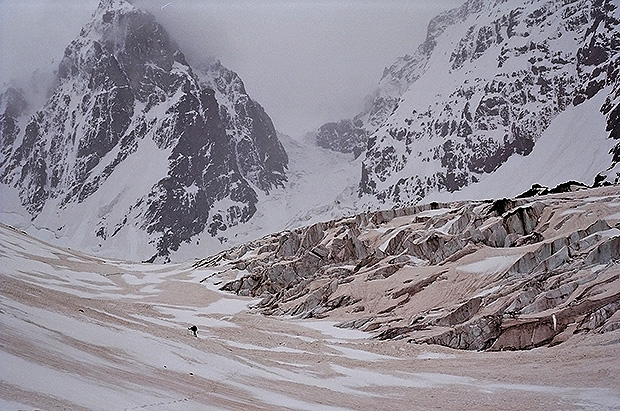
Caucasus. Approaching the Ushba Icefall from the north (long ago, before the prohibition)
Accidents have always happened in mountaineering – after all, mountains are a dangerous landform.
But without context, without explanation, these reports distort the core idea of mountaineering, creating also a distorted image of people for whom mountains are not just a pile of rocks, but an important part of their lives.
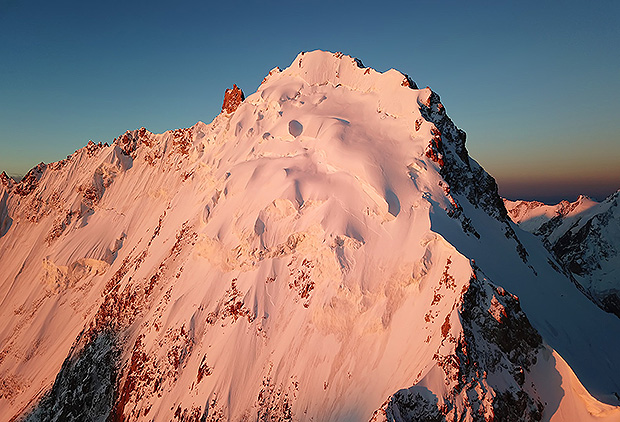
One of the most challenging and beautiful peaks in the Caucasus is Dykh tau Peak
Modern mountaineering is not a competitive sport, neither self-torture or neither a way to become a hero at any cost.
One of the most unfortunate scenarios is that heroism in mountaineering usually ends in rescue efforts and general bewilderment – "Why did this idiot climb there?"
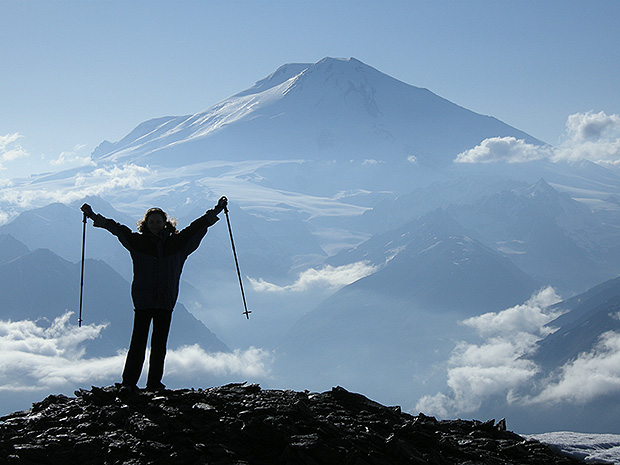
During a training climb in the Caucasus, before climbing Mount Elbrus
After this, it's difficult to explain to people outside the mountaineering community that summiting is about expanding your physical limits. It is about the highest form of control over your body and about experiencing the pure and intense emotions of contact with a crystalline, shining world.
The greatest virtue in the mountains is not conquering the nature, but the ability to coexist with it.
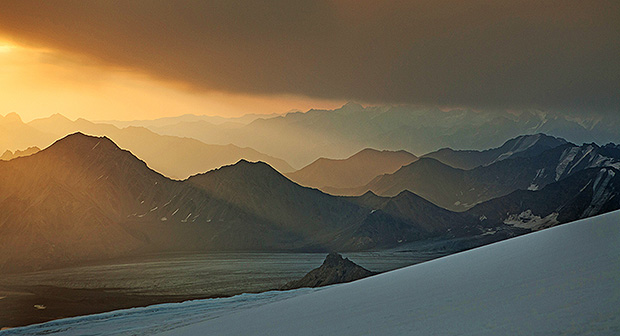
Sunset in the Mountains
Of course, climbing peaks or hiking along mountain trails in some distant locations away from the comforts of civilization is always a challenge to the forces of nature and oneself, a conscious step beyond one's usual comfort zone.
The key point is that, despite all the difficulties, the goal of the hike or climb is still to gain new, vibrant emotions, enjoyment, and useful experience, but not self-sacrifice.
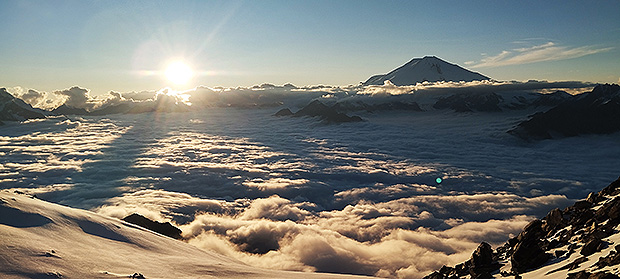
A sea of clouds over the Baksan Valley, Caucasus
In the civilized world, modern mountaineering is a form of active recreation that closely interacts with the environment.
Mountaineering is an excellent incentive, providing long-term motivation for comprehensive training and self-discipline.
Mountaineering is a way to become stronger in many ways.
Presenting mountaineering as an extreme activity, pushing people to take unnecessary risks, act recklessly, or push their limits (there's an article on this), distorts the core meaning of a beautiful and rewarding activity: mountain climbing.
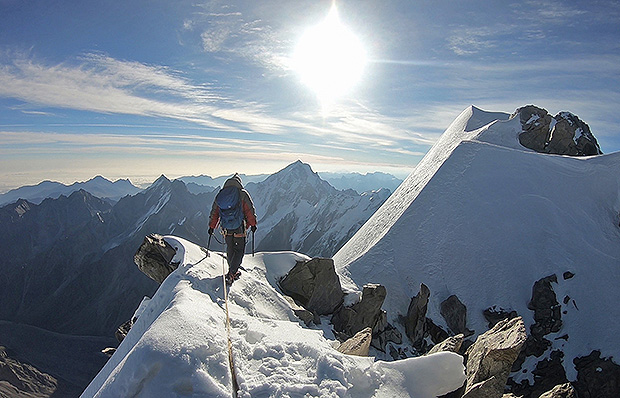
Climbing Mount Dykh tau in the Caucasus
If you choose a feasible route for which you've carefully and painstakingly prepared, you can derive immense pleasure, valuable experience, and unforgettable positive emotions from it.
At the same time, any route in the mountains, even the simplest, can become deadly dangerous if you lack correct motivation, proper training, or equipment.
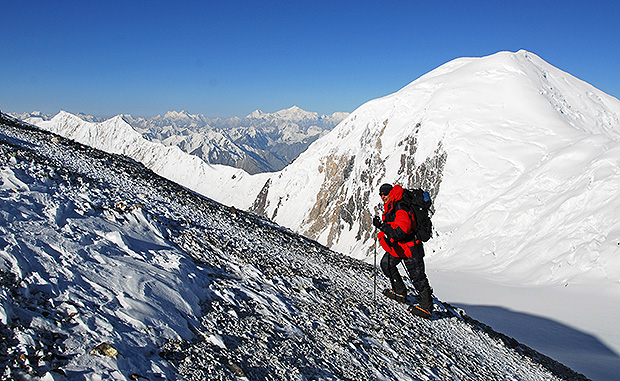
Climbing Lenin Peak, Pamir
Since mountaineering involves dangerously close contact with the forces of nature, it makes sense to cultivate a culture of safety from the very beginning when becoming interested in mountains, understanding the basic principles that always include a high risk of failure.
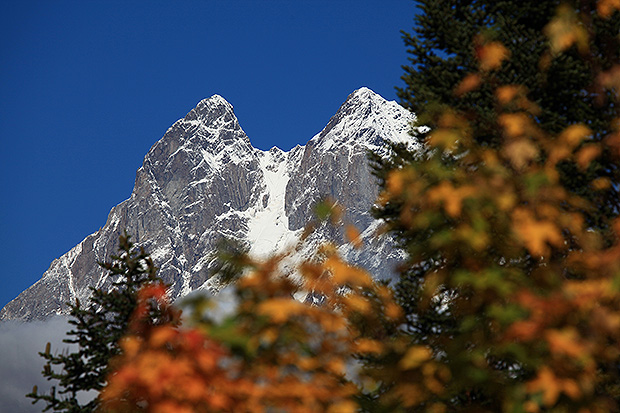
Ushba Peak, Caucasus
It's generally accepted that failure in mountaineering means, for whatever reason, failing to reach your goal - to reach the summit.
However, the summit as a goal is symbolic and has no practical value—meaning pursuing it "at any physical cost" is foolishness and a dangerous form of destructive behavioral deviation.
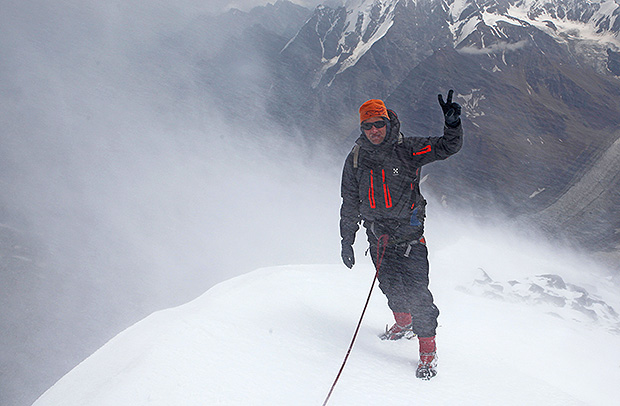
The Climax of the Ascent: The Summit
On any mountain route, true success is not reaching the summit, but returning to the start point unharmed.
No mountain is worth even a slightest harm to your health, let alone the value of human life.
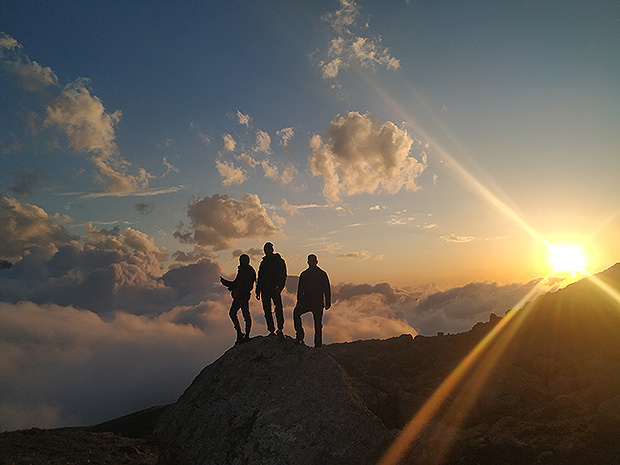
On the mountain climbing route in the mountains of Dagestan
The ability to assess circumstances correctly, anticipate possible consequences, and complete a route safely on time is the highest form of mountaineering skill.
An experienced leader or professional mountain guide on a route isn't needed to push you to the summit at all costs, but to help you return safely and on time, after weighing all potentially threatening circumstances.
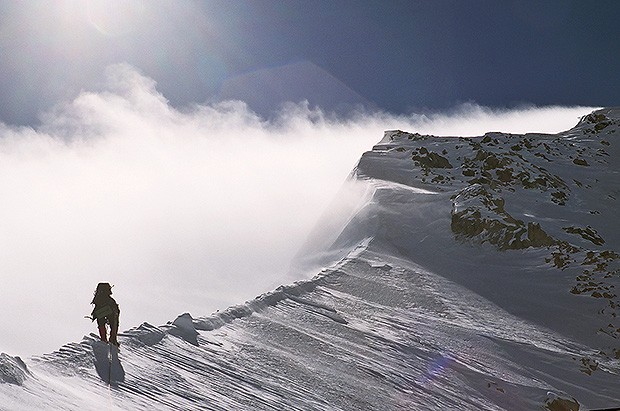
Climbing Mount Shkhara in the Caucasus
What factors can influence our plan to reach the summit and cause us to turn back before reaching our goal?
These circumstances can be objective or subjective, but in any case, they clearly take safety precedence over achieving any goal.
Objective circumstances include all factors beyond our control—weather, route conditions, dangerous natural phenomena such as avalanches, mudflows, and rockfalls—their likelihood varies depending on the specific route or season, but is always present in the mountains on any terrain, even seemingly simple ones.
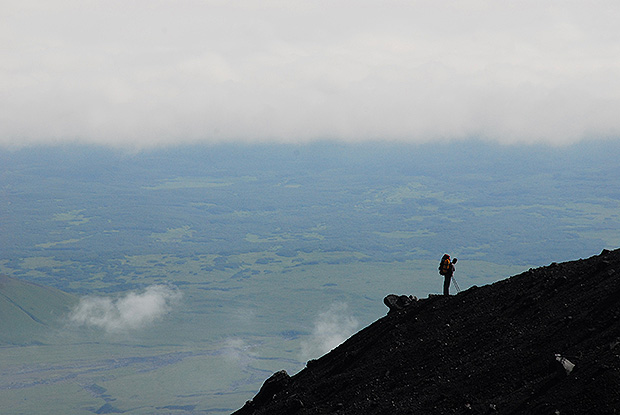
Climbing Kluchevskaya Sopka in Kamchatka
Subjective reasons for not reaching the summit may include any form of physical ailment (this should be taken extremely seriously in the mountains), lack of technical or physical fitness, or inadequate equipment.
Sometimes even a loss of motivation can be a justifiable reason for ending a route.
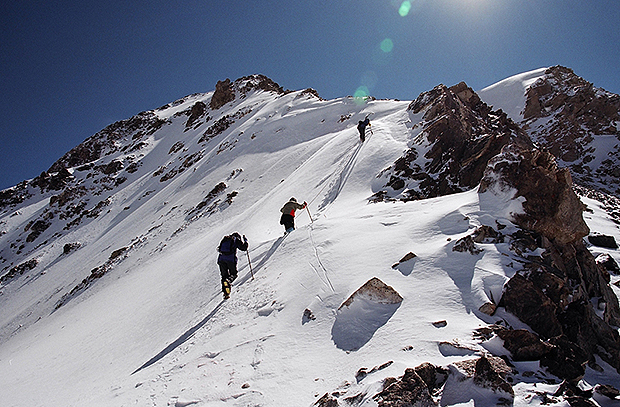
Climbing in the Caucasus
Many mountain tour organizers claim that 100% of their clients reach the summit—this is primitive marketing or, simply put, an outright lie.
There are many reasons why an ascent might not take place. When setting out on a route, you must be fully aware of this and be prepared for any failure. Remember that no summit is worth a human life.
There is no shame in abandoning the ascent and start descending. The mountain will always be there. And it's better not to climb it 100 times than not to descend from it once...
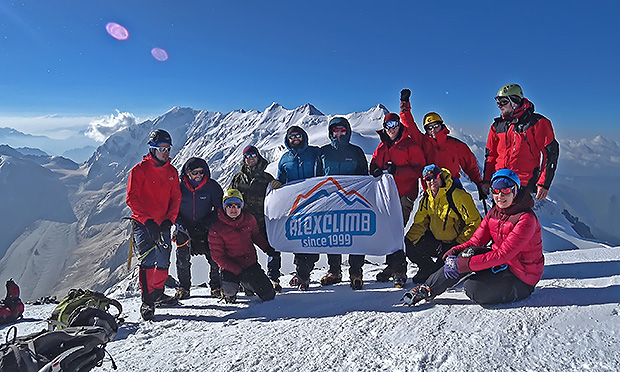
At the summit of Mount Gestola, Caucasus
I think that instead of revelling in the tragic consequences of others' mistakes and whipping up a wave of negativity against an innocent, beautiful activity - climbing the mountains, we could clearly explain the most basic attitudes and reasons why people get into trouble in the mountains.
Text and photographs by Alex Trubachev
International mountain guide, rock climbing and ice climbing coach
MCS EDIT 2025
Our Principles

AlexClimb Rule #1 - Safety First
From the very beginning of our activity, here nearly 16 years, the first Principle of work of School of mountaineering and rock-climbing of MCS AlexClimb is the Safety Priority. On the basis of this Principle all process of training is based, all programs and rounds are developed and carried out only within this main principle. We consider that at professional approach to development of programs, at personal discipline and correctly put motivation - occupations by mountaineering and rock-climbing are COMPLETELY safe. And from the return - all troubles and accidents in our sport come from nonprofessionalism, from ignorance or neglect by elementary standards of safety, from irrational motivation, from revaluation of own forces and opportunities. All these prerequisites we COMPLETELY EXCLUDE in our work - ours Rock-climbing, Ice climbing and Mountaineering are based on one Principle - the Safety Priority. In rock-climbing, mountaineering and ice climbing, the Priority of Safety of MCS AlexClimb-is your personal security and comfort irrespective of, than we are engaged - we train muscles and we work technology of the movement in the sports hall and on the rock climbing wall, we make the way through snowstorm to top or we relax on golden sand of the Caribbean beach after hot day of trainings on rocks. The Safety priority - the main credo of School of mountaineering and rock-climbing of MCS AlexClimb.

AlexClimb Rule #2 - Leave No Trace
Closely interacting with Nature, working with the active programs in mountains, woods, lakes and rivers, we perfectly understand the importance of carefull and respectfull bahavior towards the Nature, for its resources. From the very beginning of our outdoor-activity we adopted rules of Leave No Trace technique - the standard of behavior of the person accepted in all the civilized world in relation to environment and especially - to the wild nature. After all on the relation of people to the nature near which they exist, itself can draw dalekoidushchy conclusions on the relation of these people to... Where and as we didn't travel - we don't reserve any garbage, we try to reduce whenever possible our influence on environment to a minimum. We clear earlier zagryazyonny tourist parking of the left garbage, we take out and we take out to utilization places that to us other people left there. We consider that only thus, at personal individual consciousness of each citizen, each tourist, climber or autotraveller, we will be able to keep the nature surrounding us in its state, natural, suitable for life, - in it pledge of the healthy future for ourselves and our children.
