





FAQ
- Bolivia climbing questions
-
Mallorca island and rockclimbing
- What are main specifics of rockclimbing trip to Mallorca
- Mallorca island impressions
- Rockclimbing safety Spain
- Mallorca climbing accommodation
- What season is possible for rockclimbing in Mallorca
- Transport accessibility of climbing sectors in Mallorca
- Active vacation in Mallorca
- Saint Anthony night in Mallorca
- Peru climbing questions
- Gear reviews
-
Safety in the mountains
- How NOT to climb the summit?
- Mountain navigation
- At the limit of possibilities
- Mountain thunderstorm
- Russian formalities
- Solo ascents and mountain trips alone
- Mutual responsibility in mountaineering
- Safety illusions in the mountains - a rope
- Independent team of two
- Mountain troubles
- Psychological problems in the mountains
- Health in the mountains
-
Elbrus questions
- Elbrus climbing gear
- Climbing Elbrus with children?
- Mount Elbrus location?
- Elbrus logistics
- How to get to Mount Elbrus?
- Elbrus German airfield?
- Elbrus difficulty grade
- 5 points beginner must know about Elbrus
- How to prepare for Elbrus?
- Are there avalanches on Mount Elbrus?
- Climbing Elbrus solo?
- Seasonality of climbing Mount Elbrus
- How much time climbing Elbrus takes?
- Clothes for Mount Elbrus?
- Pressure at the top of Elbrus?
- Elbrus air temperature
- Elbrus sightseeing
- How much to climb Elbrus
- Gear questions
- Mountaineering questions
- Mountain climbing training
-
Rockclimbing questions
- Rockclimbing gear
- How to choose your first rockclimbing shoes
- The hand power in roclcimbing
- What is Rockclimbing tours
- Non olymnic rockclimbing
- What is rockclimbing?
- Where do you climb?
- Where and when we organize our rockclimbing programs?
- What is rockclimbing?
- Rockcliming program class?
- Climbing motivation
- Horse riding tours
- Iceclimbing questions
-
Questions on the alpine programs
- What to climb in Morocco?
- Weekend summit climb
- Georgia 2023
- Pico Aneto - what is that mountain?
- Mountain programs format
- Mountain climbing food ration
- Queries on the alpine program climbing Mount Bazarduzu
- Top 10 Questions About Climbing Kamchatka Volcanoes
- What is combined program?
- What is sightseeing program?
- What is pilot program?
- What programs you have of the medium complexity level?
- Basic expedition rations
- Prices for the mountain climbing programs
- Queries on the Mountain Course in Adyl Su valley
- Program complexity?
- Questions about MCS AlexClimb
- Questions related to trekking programs
Top 10 Questions About Climbing Kamchatka Volcanoes
Text version in English for mobile devices
Versión del texto en español para dispositivos móviles
MCS AlexClimb Programs in Kamchatka
Below I will answer in detail the 10 most frequently asked questions about my climbing programs in Kamchatka – ascent to volcanoes Kluchevskaya Sopka, Shiveluch, Krestovsky, and Kamen.
- How difficult is climbing in Kamchatka, and what are the challenges?
- Which route is best for climbing Kluchevskaya Sopka?
- What risks are participants exposed to when climbing Kamchatka volcanoes?
- What is the backpack weight, and how long will it take to carry it?
- What are the footwear requirements for climbing Kamchatka volcanoes?
- What amenities are available for participants while climbing Kamchatka volcanoes?
- Physical fitness requirements for climbing the volcanoes of Kamchatka?
- What are the personal equipment requirements for climbing the volcanoes of Kamchatka?
- What is the best season for climbing volcanoes in Kamchatka?
- What communication is available in the Kluchevskaya group of volcanoes in Kamchatka?
Answer: The climbs in Kamchatka are difficult and challenging. Due to the region's inaccessibility and autonomous nature of the routes, climbing in Kamchatka is more challenging than climbing in more civilized mountain regions like the Caucasus or the Alps.
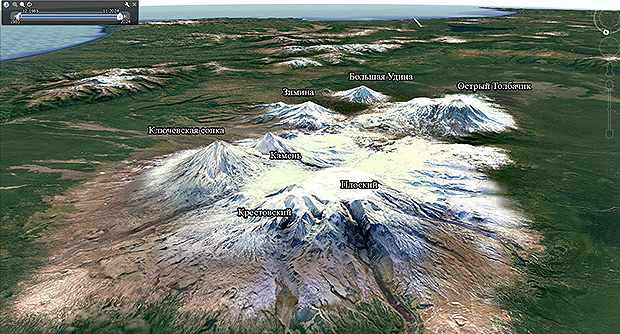
Kluchevskaya Group of Volcanoes in Kamchatka
Any climb in Kamchatka, especially if we're talking about routes in the Kluchevskaya Group of Volcanoes, is a serious, autonomous mountain expedition conducted without service support.
The difficulty of the Kamchatka volcano climbing programs is determined by the following factors:
- the significant remoteness of the climbing area from centers of civilization,
- the lack of a developed or even operational rescue service,
- lack of route markings on the terrain,
- volcanic terrain makes trekking and climbing specifically difficult
The participants of the climbing expedition endure high loads associated with the need to carry all expedition equipment and food.
Using porters or pack animals for this purpose in Kamchatka is impossible due to the complete lack of such services.
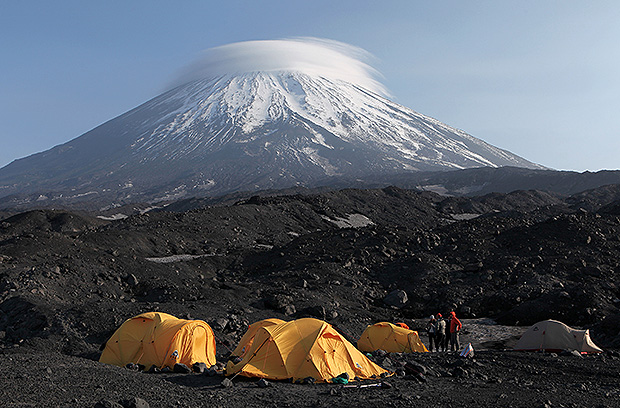
At the foot of Kluchevskaya Sopka
Furthermore, another difficulty of climbing routes in Kamchatka is the extremely unstable weather in the climbing area, due to the peninsula's geography.
The Kluchevskaya group of volcanoes is particularly susceptible to sudden wind intensifications and changes in direction. Due to the sharp changes in altitude and the presence of glaciation, the likelihood of precipitation is higher than on the flat part of Kamchatka.
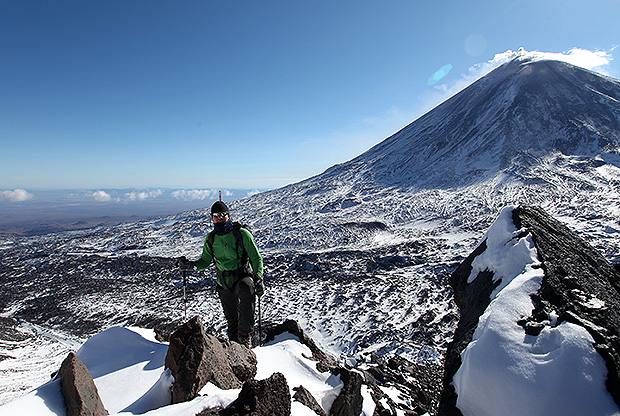
Climbing Sredny (Middle) Volcano in the Kluchevskaya Group of Volcanoes
The tactical difficulties of the mountain routes in Kamchatka stem from the risks that are atypical for mountaineering ascents - including: the possibility of increased volcanic activity, the instability of dangerous sections of the slopes of the volcano, high probability of encountering dangerous wildlife - bears, wolves, and even wolverines.
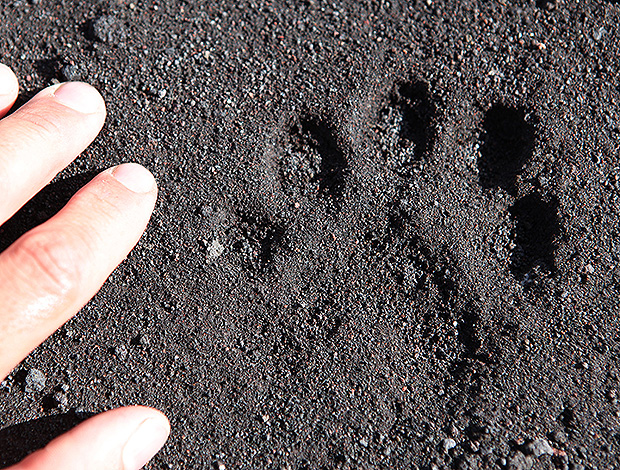
Wolverine footprints found in the morning close to our camp at the foot of Kluchevskaya Sopka
These factors make managing such programs challenging from a tactical and logistical standpoint, as they require not just mountaineering experience, but experience interacting with a multitude of factors which are unique to Kamchatka.
Question 2. Which route is best for climbing Kluchevskaya Sopka volcano?
Answer: The priority when choosing an ascent route should always be its objective safety. Considering the risks and specifics of climbing in Kamchatka, particularly in the Kluchevskaya group of volcanoes, I always try to choose a route with the lowest possible level of objective danger.
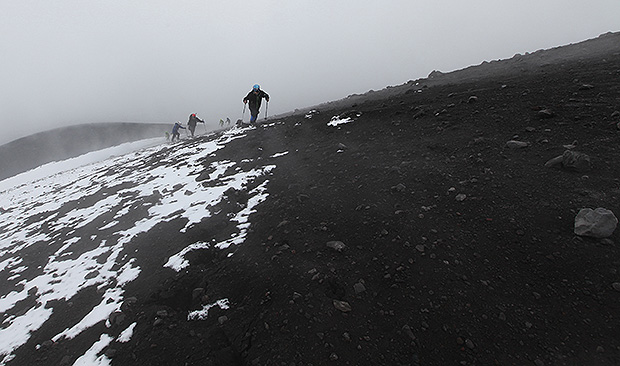
Group ascent to the crater of the highest volcano in Kamchatka - Kluchevskaya Sopka
In Kamchatka, one of the highest objective risks is the risk of rockfall. Icy slopes, especially those exposed to the sun, are prone to this danger. For this reason, for many years, for climbing Kluchevskaya Sopka I choose the North route.
Despite the logistical complexity (very long upper section), the objective danger on this route is comparatively lower than on the southern route, as the northern slope is less heated by the sun.
It cannot be said that the northern slope of Kluchevskaya Sopka is always safe to climb, but this is an uncertainty associated with the specifics of climbing a regularly erupting volcano.
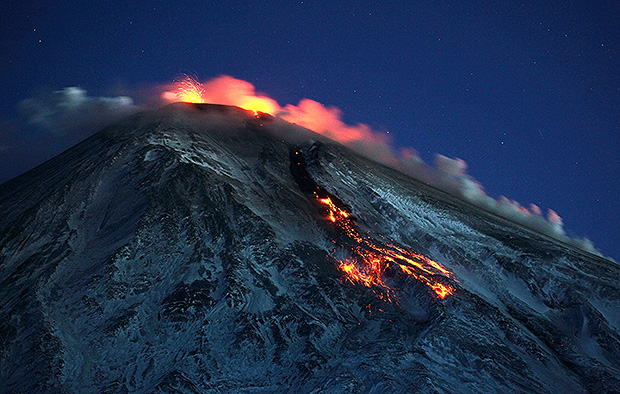
Lava breakthrough on the southeastern slope of Kluchevskaya Sopka
Choosing a route when climbing an active volcano, one must take into account the instability of the slopes after the recent eruptions—massive landslides are possible in these areas. Definitely those sides of the volcanic cone where recent eruptions have occurred should be avoided.
Furthermore, when choosing the route for my expedition, I am guided by tactical considerations. Choosing the shortest route from the entry and exit points reduces the overall volume of the expedition cargo and increases the chances of a quick retreat to the evacuation point in case of an emergency.
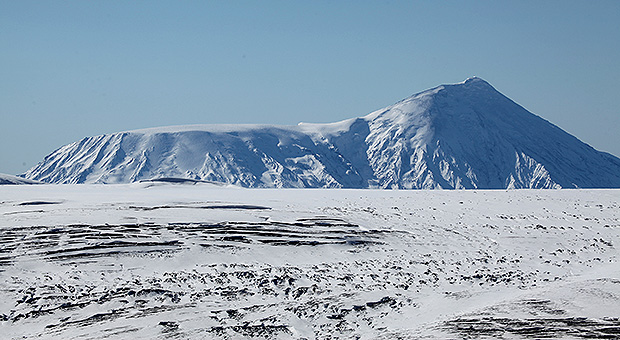
Erman Glacier and Ostry (Sharp) Tolbachik Volcano
Question 3. What risks the participants in the Kamchatka volcanoes climbing programs are exposed to?
Answer: Without going into a description of the subjective risks typical of any mountain region and associated exclusively with the incompetent actions of the group, I will move directly to the objective factors.
In addition to the usual set of mountaineering risks inherent in any mountain route (bad weather, mudflows, avalanches, rockfalls), Kamchatka poses some specific dangers associated with the peculiarities of this wild and inaccessible region.
The main danger and peculiarity of Kamchatka lies in its unique volcanic nature. In fact, the mountains of Kamchatka are not mountains in the usual sense of the word – they are active volcanoes.
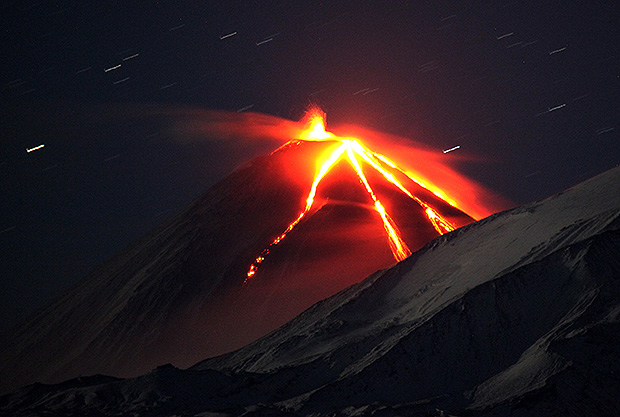
Massive eruption of Kluchevskaya Sopka
For the climbers this natural phenomenon goes together with the most serious risks – unpredictable volcanic activity, the possibility of an eruption or volcanic ash emission, frequent earthquakes causing massive avalanches and rockfalls.
All this makes Kamchatka exceptionally difficult for climbing and requires extreme caution when developing a tactical plan for a climbing route.
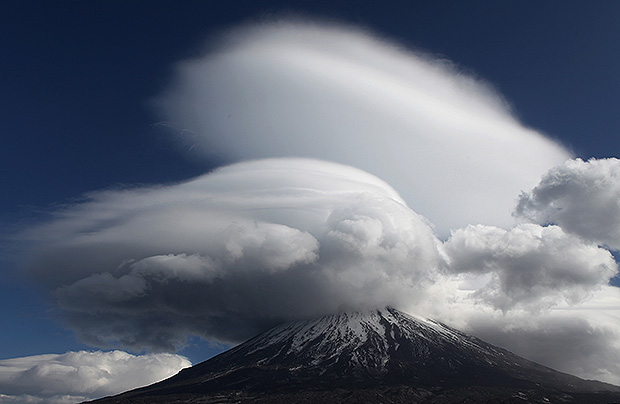
Localized bad weather on Kluchevskaya Sopka - critically strong winds in the upper part of the volcanic cone
Kamchatka's tourist infrastructure is very poorly developed – therefore the possibility of helicopter evacuation from the route is very doubtful.
Unstable weather conditions and the lack of a modern helicopter fleet make it difficult to seriously count on a timely outside assistance in the event of an accident.
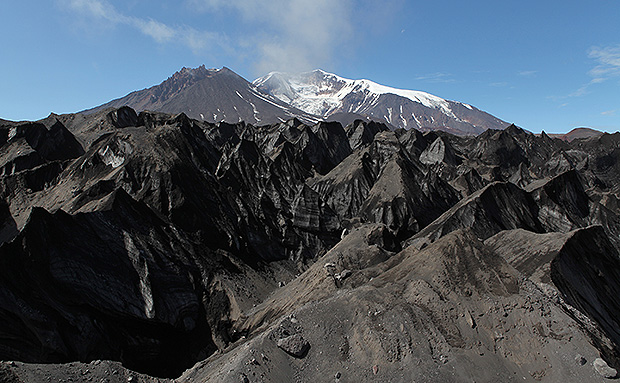
Erman Glacier covered with volcanic ash
It should not be forgotten that Kamchatka's wildlife has remained pristine. The abundance and activity of wild animals impose certain requirements on route planning and equipment selection. Wild animals generally avoid people, but if there is a high concentration of them in an area of your climbing route, you should be prepared for any unforeseen situations.
It is recommended to have and know how to use personal safety equipment, such as a flash flare and an special self-protection spray from the wild animals. All the participants should know how to behave if a wild animal behaves threateningly.
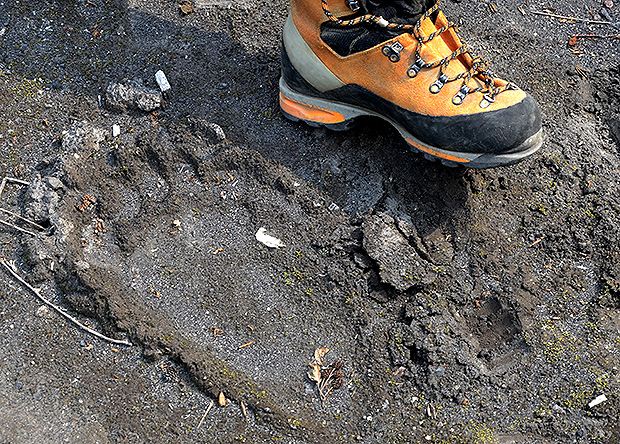
Kamchatka bear footprint - compared to a climbing shoe of 45 size
Also, one should not forget about some inconveniences that are not as obvious as fountains of erupting lava or bears wandering around the area.
In particular, in July and August, mosquito and flies activity in Kamchatka is so high that it can create serious problems for the tourists even at significant altitudes (sometimes a cloud of mosquitoes accompanies the group up to 2500-2700 m).
Moving along the route, especially in the lower part - in the forest zone, without special protective equipment (mosquito nets, chemicals, sprays) often is complicated or even impossible.
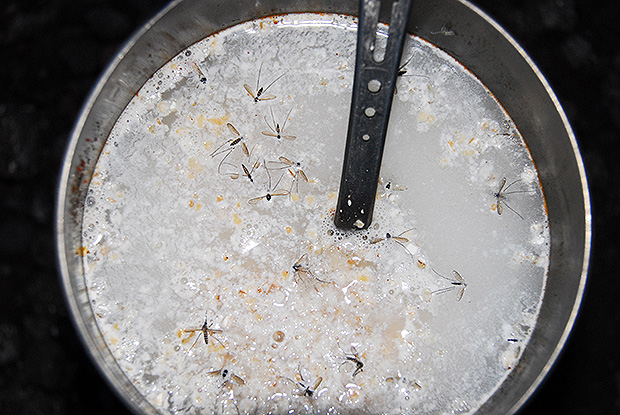
Mosquitos in my breakfast porridge at the altitude of 3000 meters
Answer: The backpack will be really heavy. Climbing in the Kluchevskaya group of volcanoes in Kamchatka involves long periods of independent mountain expeditions and the need to transport a full set of expedition gear and food.
The specific nature of the climbing routes requires the use of a set of mountaineering equipment – crampons, harnesses, ropes, helmets, ice axes, etc.
Since there are no porters, all communal gear is distributed equally among the participants of the program. The set of the shared equipment, to carry of which is the responsibility of each participant, weighs approximately 6-8 kg.
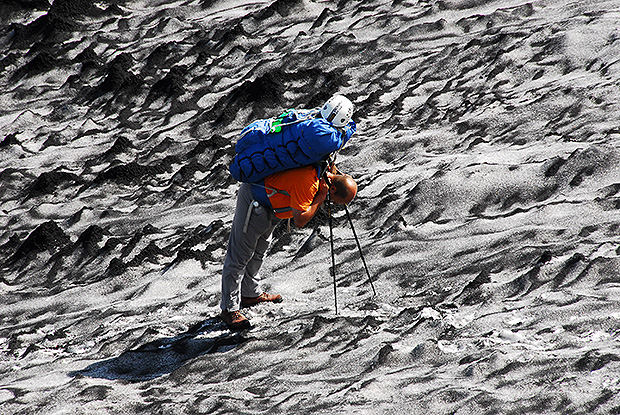
From under a heavy backpack, the beauty of Kamchatka isn't always as pleasing to the eye as in the photographs
The duration of climbing routes in the Kluchevskaya group of volcanoes ranges from 5 to 12 days, the standard food set for such routes weighs from 4 (extreme austerity) to 10 (almost abundance) kilograms.
The positive side of the issue is that by the end of the route, the backpack will get lighter for the weight of its food part.
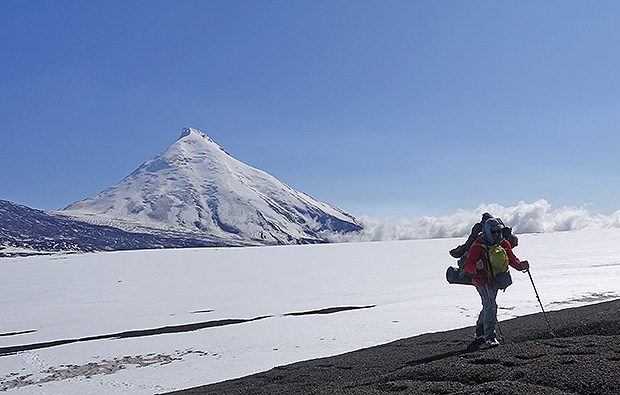
Carrying load during the ascent of Kamen volcano (32 kg backpack)
Summary: In addition to the weight of the backpack with personal gear (clothing, sleeping equipment, personal belongings), at least 12 kg of shared load (food and equipment) will be added. In most cases, the backpack weight at the beginning of the route is 28-30 kg.
You should be extremely careful when assembling your personal gear, eliminating any unnecessary or duplicate elements, making every piece of clothing and equipment as light as possible.
Question 5. What are the requirements for special alpine footwear for climbing Kamchatka volcanoes?
Answer: High-quality mountaineering footwear is one of the most important pieces of the equipment, determining not just your comfort but the safety of the entire trip.
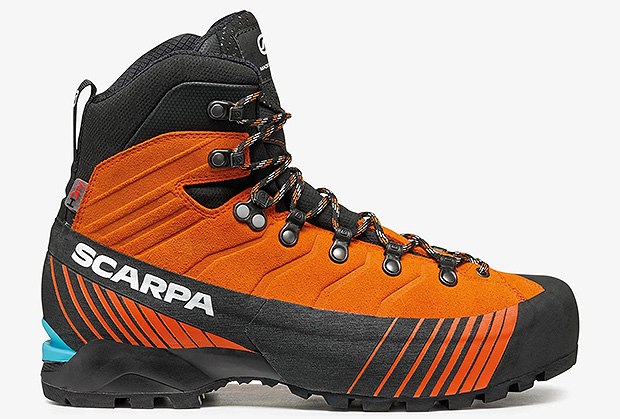
The optimal mountaineering boot I use or climbing in Kamchatka is Scarpa Ribelle, a pair weighing 695 grams.
Since most of the Kamchatka climbing routes lay in the difficult terrain, you should choose only models from trusted manufacturers, avoiding any compromises in quality.
Climbing in Kamchatka requires using either high-quality four-season trekking boots or any model of alpine mountaineering boots for summer climbing. Since we use lightweight, soft binding mountaineering crampons, special constructions of the front and heel are not necessary, but the sole design of the boot and ankle support must be rigid.
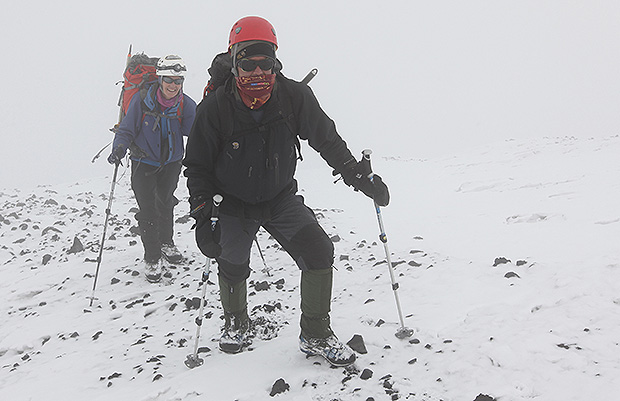
Specifics of using mountaineering footwear when climbing in Kamchatka
The climbing boots should be fairly new but not right from the box, comfortable and of the right size – with some room for thick socks.
There should be no doubt about the quality and reliability of the footwear. Any problem with the boots during the climbing expedition could lead to the end of the route or even the need for evacuation. Crossing the volcanic terrain with a broken boot or a detached sole is almost impossible.
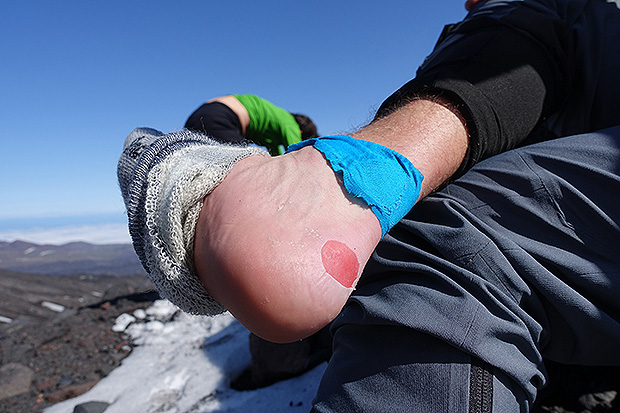
Consequences of choosing the wrong boot size for climbing Kluchevskaya Sopka volcano
Answer: None. A few tiny shelters (volcanologists' huts) make it impossible to seriously consider spending the night in a shelter. They can be critically cluttered, occupied, broken. Expecting to spend the night during your route to Kamchatka volcanos in anything more comfortable than a tent is an illusion.
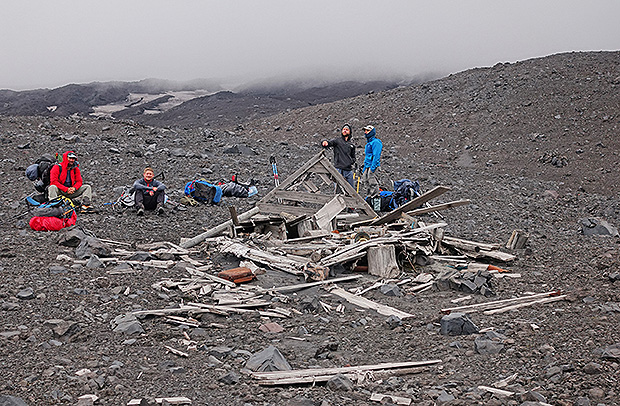
The volcanologists' hut is a bit out of condition
Despite the occasional small lakes along the climbing route, you shouldn't count on proper personal hygiene either - the water temperature in the mountain lakes is only slightly above freezing.
The starting point of the route - Kluchi village doesn't offer a wide range of tourist options - it's a remote provincial settlement without any tourist infrastructure.
Those who seek for comfort should be patient until the end of the expedition - from the departure to the end of the route there will be no civilized options for relaxation until the return to Petropavlovsk-Kamchatsky.
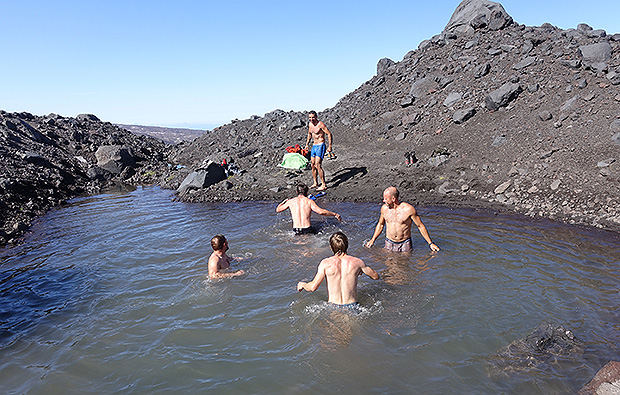
Swimming in the lake on the slope of Kluchevskaya Sopka is more about extreme than hygiene
Answer: For more information on the preparing for ascents of different difficulty levels, you can read my article about preparing for mountaineering ascents.
The Kamchatka volcano ascent programs, particularly one of Kluchevskaya Sopka, is challenging and very demanding on the participants physical fitness. Generally, most volcano routes do not require special climbing skills but these routes are associated with very intense physical exertion, comparable to the ascents of 6,000+ meter mountains.
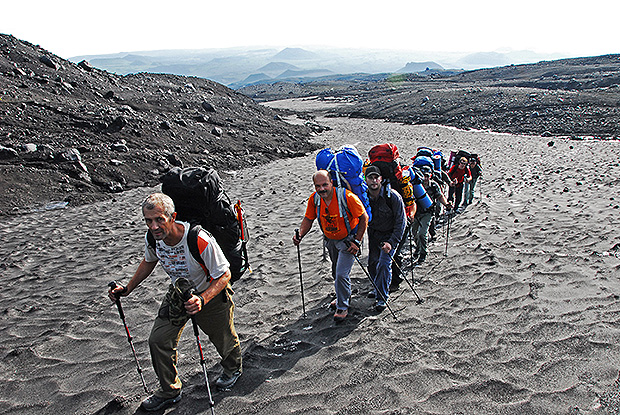
Climbing Kluchevskaya Sopka volcano
Many experienced climbers who ascented volcano Kluchevskaya Sopka with me claimed that this route in terms of difficulty can be compared to climbing Aconcagua or even Peak Lenin.
The high level of the physical load is, in particular, connected with very long way from the camp to the "summit" - the upper rim of the volcano's crater. On many Kamchatka routes, the elevation gain on the summit day is more than 2,000 meters.
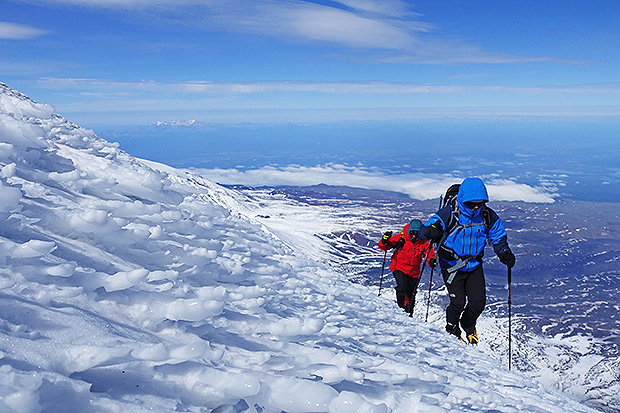
On the snow-covered dome of Kluchevskaya Sopka
The effect of the oxygen deficiency at the same altitudes in Kamchatka with the subjective sensation, for example, on Kilimanjaro - the difference will be about 1,200-1,500 m. Due to Kamchatka's geographic location, the effects of hypoxia at an altitude of 3,000 meters can be felt approximately as at the altitudes of 4,200-4,500 m on the more close to the equator mountains.
The lack of proper options to acclimatize, the continuous climb, the difficult terrain, and the expedition format require a high level of physical fitness and hiking experience for all the participants in Kamchatka climbing expedition.
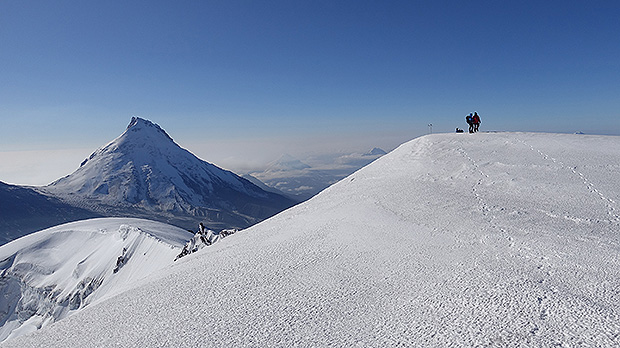
Climbing Kamchatka Volcanoes with the MCS AlexClimb Team
How to prepare? - You should train general physical endurance – running, cross-fit. Although it is not so important directly for Kamchatka routes, don't forget about coordination training – rock climbing, gymnastics. These activities help improve safety and conserve energy when moving across the difficult terrain.
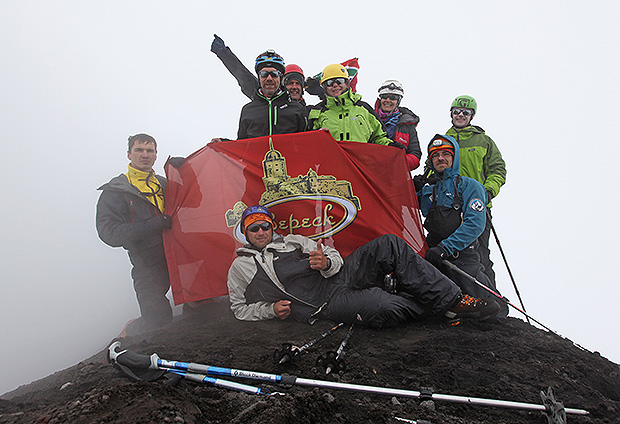
At the "summit" of the Kluchevskaya Sopka volcano
Answer: As for any expedition-style mountaineering program, the first and most important requirement for the equipment is its weight. Equipment must be of adequate quality, as any breakdown or malfunction can have disastrous consequences during an independent expedition in extremely remote location.
The issue of equipment for this class of mountaineering program is described in detail in my article
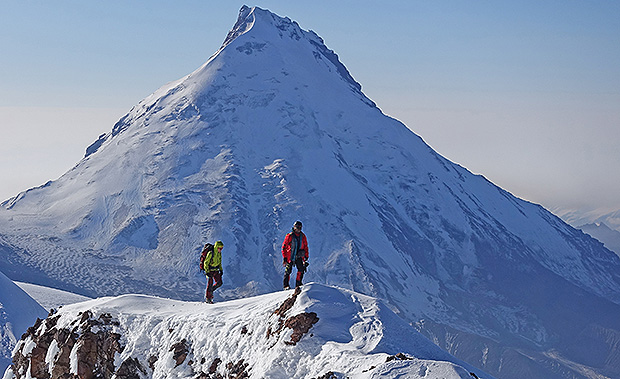
Climbing Kamchatka Volcanoes with the MCS AlexClimb Team
Answer: A distinctive feature of Kamchatka's climate is its extremely unstable weather and sharply defined seasons, which, as locals joke, there are only two in Kamchatka: a long winter and a short summer.
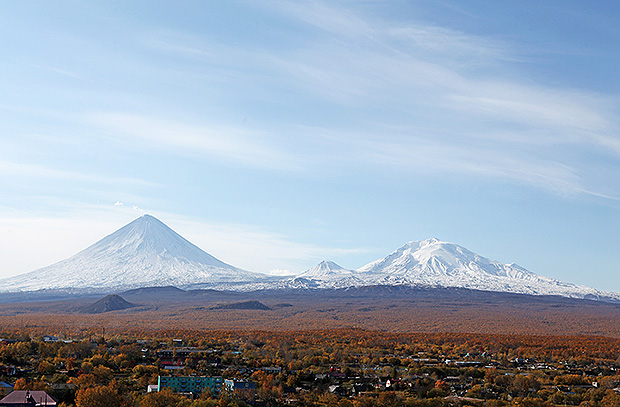
Autumn in Kamchatka - divinely beautiful and hellishly cold on the volcanoes
The choice of the periods of favorable weather combined with safe route conditions for mountaineering in Kamchatka is very limited.
As a rule, the necessary parameters converge by the end of July. The period of relatively good weather lasts no more than three to five weeks.
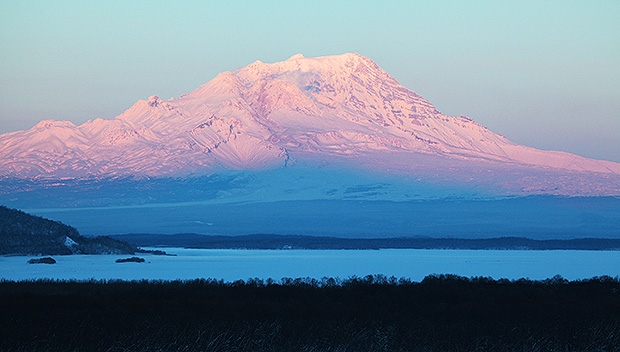
Winter colors of the Shiveluch Volcano - a rare case when it is not covered with a cloud of smoke from an eruption
Choosing any other season or period adds additional risks to the climbing program and reduces the chances for a successful ascent.
Question 10. What communication is available in the Kluchevskaya group of volcanoes in Kamchatka?
Answer: As of 2025, the north and northwest sides of Kluchevskaya Sopka volcano are covered by a cellular signal (Megafon RUS). The signal quality is suitable for mobile internet use, although it depends on various factors, including weather.
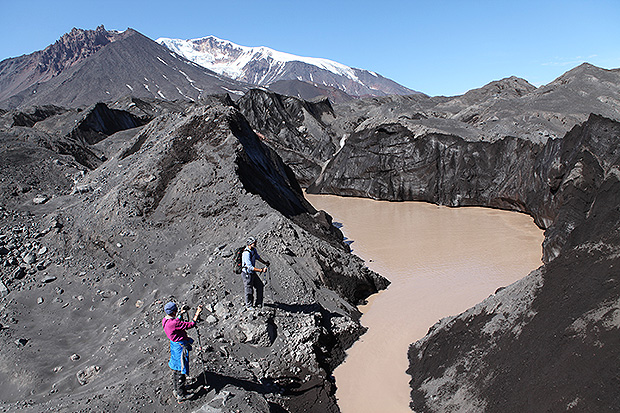
During the expeditions in Kamchatka, communication is a key aspect of safety.
As an alternative communication mode, a satellite terminal is recommended – the Iridium system provides reliable service.
To coordinate the group's actions in the event of an emergency, a compact VHF radio set is used; however, this communication device is intended for short distance communication only.
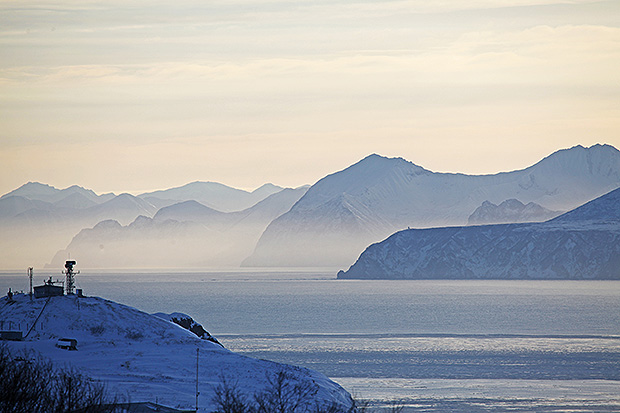
In any season and in any weather - Kamchatka is incredibly beautiful land
Text and photographs by Alex Trubachev
Your guide to the volcanoes of Kamchatka
MCS EDIT 2025
Our Principles

AlexClimb Rule #1 - Safety First
From the very beginning of our activity, here nearly 16 years, the first Principle of work of School of mountaineering and rock-climbing of MCS AlexClimb is the Safety Priority. On the basis of this Principle all process of training is based, all programs and rounds are developed and carried out only within this main principle. We consider that at professional approach to development of programs, at personal discipline and correctly put motivation - occupations by mountaineering and rock-climbing are COMPLETELY safe. And from the return - all troubles and accidents in our sport come from nonprofessionalism, from ignorance or neglect by elementary standards of safety, from irrational motivation, from revaluation of own forces and opportunities. All these prerequisites we COMPLETELY EXCLUDE in our work - ours Rock-climbing, Ice climbing and Mountaineering are based on one Principle - the Safety Priority. In rock-climbing, mountaineering and ice climbing, the Priority of Safety of MCS AlexClimb-is your personal security and comfort irrespective of, than we are engaged - we train muscles and we work technology of the movement in the sports hall and on the rock climbing wall, we make the way through snowstorm to top or we relax on golden sand of the Caribbean beach after hot day of trainings on rocks. The Safety priority - the main credo of School of mountaineering and rock-climbing of MCS AlexClimb.

AlexClimb Rule #2 - Leave No Trace
Closely interacting with Nature, working with the active programs in mountains, woods, lakes and rivers, we perfectly understand the importance of carefull and respectfull bahavior towards the Nature, for its resources. From the very beginning of our outdoor-activity we adopted rules of Leave No Trace technique - the standard of behavior of the person accepted in all the civilized world in relation to environment and especially - to the wild nature. After all on the relation of people to the nature near which they exist, itself can draw dalekoidushchy conclusions on the relation of these people to... Where and as we didn't travel - we don't reserve any garbage, we try to reduce whenever possible our influence on environment to a minimum. We clear earlier zagryazyonny tourist parking of the left garbage, we take out and we take out to utilization places that to us other people left there. We consider that only thus, at personal individual consciousness of each citizen, each tourist, climber or autotraveller, we will be able to keep the nature surrounding us in its state, natural, suitable for life, - in it pledge of the healthy future for ourselves and our children.
