





About us
- Project Overview
- Concept
- Safe mountain climbing
- Safe rock climbing
- Gift sertificates
- Courses
- Feedback
-
Articles
-
Lirics, enigmas and misterios of mountain climbing
- Climbing psychology
- Kamchatka sea lions
- Ten best mountains of the world
- Machu Picchu Mystery
- Menorca - the mystery of the Talaiots
- Russian climbing reality
- The Camel
- Dyatlov group tragedy - version with no mystics
- Abandoned lighthouse
- Gaucho Argentina
- Horses and mountains
- Akershus Fortress
- Bergen, Norway
- Black Ufany forest
- On the benefits of evening walks
- The Child
- Bezengi - the arena of the Death: The Mizhirgi Tragedy
- Bezengi Arena of Death: Tragedy on Dykh-Tau
- Dykh-Tau – History of the First Ascent (1888)
- The Pilot's ring
-
Stories about alpine climbing trips
- South Ushba via 3 buttress
- Ojos del Salado Arg side 2023
- Khan Tengri Edge of risk
- Dykh Tau and Bezengi 2023
- Mount Belukha - the Princess of Altai
- Climbing Alpamayo 2023
- Season 2023 completed
- Season 2023 specifics
- Climbing Monblan 2022
- Lifeless Sierra smiles
- Cerro Torre 50
- Siula Grande
- Climbing Kazbek. Georgia
- Ushba mountain beach
- North Ushba climb
- Morocco, Toubkal climbing
- The Life of the Valley of Sun
- Ushba. Forbidden Mountain
- Peak Lenin Climb
- Kilimanjaro climb
- Elbrus. Today, yesterday and tomorrow
- Mount Kenya climb
- Wind, Rocks and South Cross
- Kluchevskaya Sopka climb
- Peru climbing
- Touching the Legend
- Solo climb of Matterhorn
- Elbrus. Interview with rescuer
- Elbrus - the live legend
- Tian Shan, Peak Komsomol climb
- Khan Tnegri from the North
- International Ushba climb 2002
- Ushba 2002. Author Sergey Zabrodin
- Svanetia, Caucasus from the South
- Climbing Matterhorn - first article
- Climbing Belukha, Altay
-
Rockclimbing stories
- Menorca rockclimbing
- Tenerife rockclimbing
- Climbing in Mallorca January 2023
- Montserrat
- Majorca rockclimbing report 2014
- Rockclimbing in Peru - Huaraz 2023
- Mallorca rockclimbing December 2023
- Brazil rockclimbing
- Canary Islands and Tenerife
- Georgia Rockcimbing
- Madagascar rockclimbing
- Rockclimbing trip to Kalymnos, Autumn 2014
- Rockclimbing trip to Kalymnos, Spring 2014
- Rockclimbimg in Cuba
- Quadras or the architecture of the gods
- Rockcliming Armenia
- Cuba far away
- Crimea winter Rockclimbing
- Gear reviews, repairs, fails
- Iceclimbing trip stories
-
Lirics, enigmas and misterios of mountain climbing
- Codex of Mountain Guide
Dykh-Tau – History of the First Ascent (1888)
Mobile version of the articlen English
Versión del texto en español para dispositivos móviles
Dykh-Tau climbing programm by MCS AlexClimb
----------------------
It was 1888. Alexander III ruled Russia, Jack the Ripper was still eluding the police in London, the first Kodak camera had been introduced in the United States, and Queen Victoria, at the age of 69, was alive and well.
Europe was living without major wars. In Russia, too, nothing seemed to foreshadow the troubles that lay ahead.
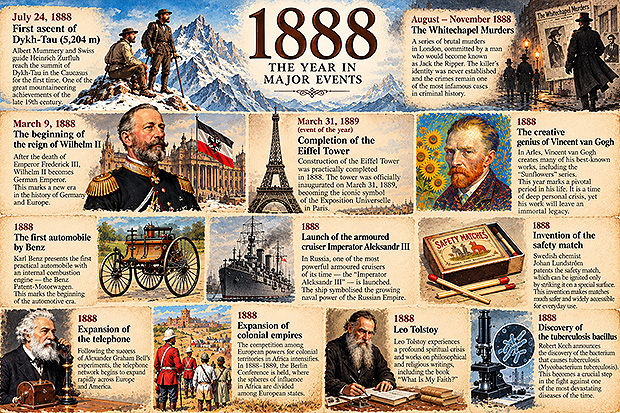
1888: The Year in Major Events
Such was this rather cosy little corner of history at the end of the nineteenth century. That same year, with no aspirations to worldwide fame or the laurels of champions, a handful of people succeeded in an undertaking that never found its way into the chronicles of world history.
Yet to this day, their achievement inspires astonishment and an almost reverential awe at the courage, self-sacrifice and phenomenal strength of spirit of those who left their mark on the history of world mountaineering.
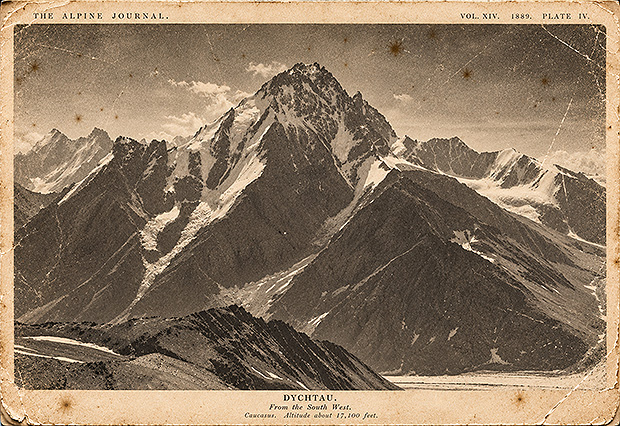
Historic photograph of the southern side of Dykh-Tau, taken from the slopes of Katyn-Tau
I want to tell the story of how, during a private British mountaineering expedition in 1888, first ascents were made and new routes opened on some of the most formidable peaks of the Caucasus: Dykh-Tau, Ushba, Shkhara, Katyn-Tau and Jangi-Tau.
For those to whom these names mean little, let me explain.
Even today, these mountains are regarded as some of the most difficult and dangerous peaks in the Caucasus. Not every mountaineer, even among professionals, can boast of having climbed so much as a few of them.
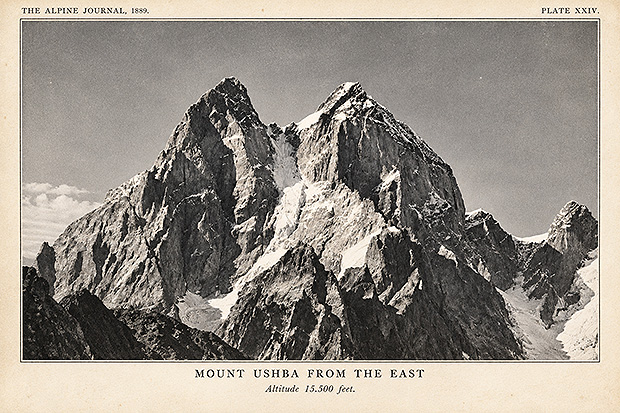
Ushba — another iconic Caucasian summit. Its first ascent brought Cockin's legendary expedition of 1888 to a close
What follows is my translation, reproduced almost without alteration, of the original account of the ascent of Dykh-Tau, published in the February 1889 issue of the Alpine Journal under the title “An Expedition to the Caucasus”, by H. W. Holder. My own comments and references to the modern route appear in parentheses.
---------------------------------
On August 10, a party of Englishmen consisting of J. G. Cockin, H. W. Holder and Hermann Woolley, accompanied by the Grindelwald guides Ulrich Almer and Christian Roth, left Rostov-on-Don to explore the mountains at the head of the Bezengi Glacier.
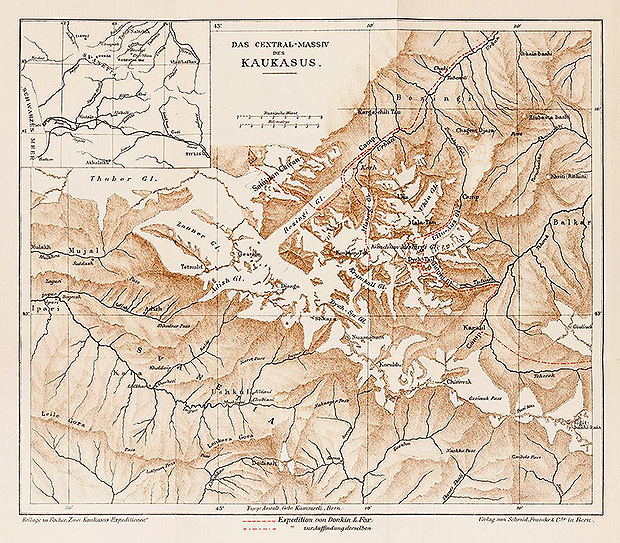
An original nineteenth-century map of the Bezengi region, showing the route of Donkin and Fox's ill-fated expedition
During the following day they reached the Cossack settlement of Kotlyarovskaya and, travelling as quickly as possible, arrived in Nalchik on the evening of August 11, and in the village of Bezengi at noon on August 14.
On the afternoon of August 15, they pitched their tent on the eastern side of the Bezengi Glacier, at an altitude of approximately 2,560 metres, near a shelter known to the local inhabitants as Misses Kosh.
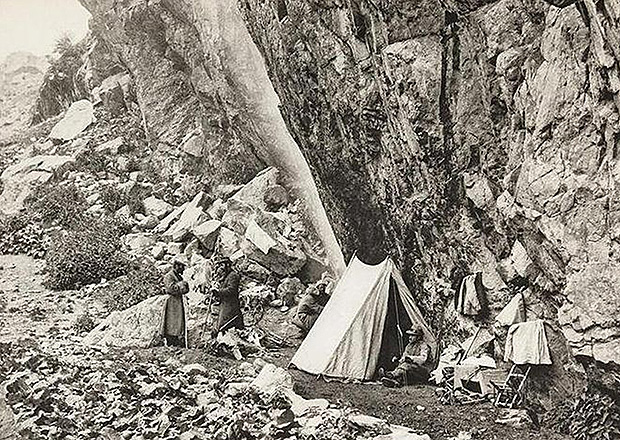
The expedition camp at Misses Kosh, 1888
The First Attempt
The following day, they set out for Dykh-Tau.
After spending the night on rocks a little above the lower icefall (the southwestern branch of the Misses Glacier; this section does not coincide with the modern route — A. T.), the party resumed its ascent early in the morning, following the line attempted unsuccessfully by Dent and Donkin in 1886.
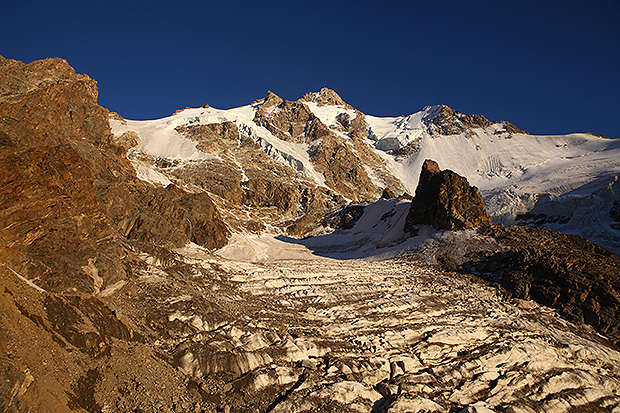
The western slopes of Dykh-Tau. Contemporary photograph by Alexey Trubachev
They reached the “ochre-red” rocks, where impassable gendarmes forced them to make a detour towards the southern face of the southwest ridge.
After two or three unsuccessful attempts to negotiate the white rocks, they managed to climb, keeping close to a couloir, to an altitude of approximately 4,880 metres (on this first attempt, they climbed directly towards the gendarme now known as the “VTsSPS Bivouacs”, thus bypassing the entire lower section of the North Ridge — A. T.).
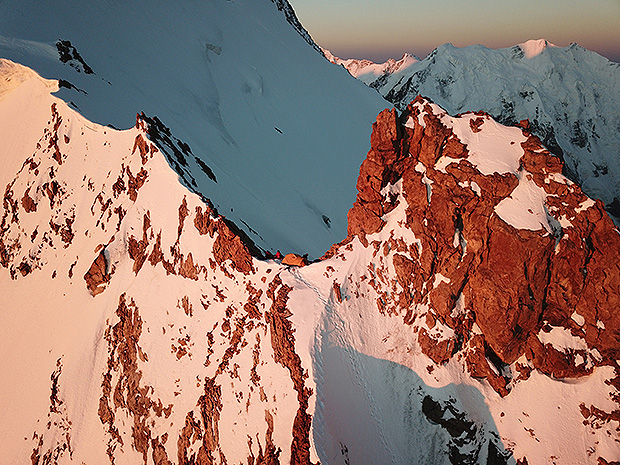
The rock gendarme at 4,800 metres on the North Ridge of Dykh-Tau (the 4,800 m bivouac site). Contemporary photograph by Alexey Trubachev
By then, however, the day was already so far advanced that they were forced to abandon the ascent and return to their tent.
The Successful Ascent of Dykh-Tau, August 19–20, 1888.
Three days later, another attempt was made on Dykh-Tau, this time by the North Ridge.
The party spent the night of August 19 on a rocky ledge at approximately 3,600 metres, on the right bank of the Misses Glacier — the middle of the three glaciers shown on Mr Freshfield's latest map.
They set out at 4:45 a.m.
At 8:00 a.m., they reached the depression in the North Ridge overlooking the Mizhirgi basin (the Misses–Dykh Col — A. T.).
The summit of Dykh-Tau was reached at 2:05 p.m.
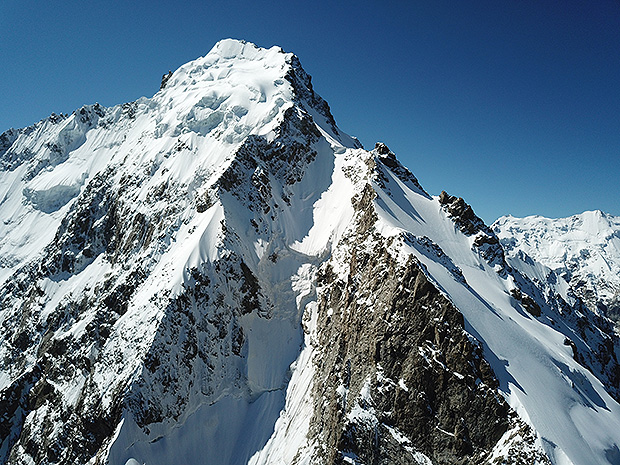
The Dykh-Tau massif from the north. Contemporary photograph by Alexey Trubachev
Snow conditions varied considerably, but for the most part the snow was soft and unconsolidated, making progress extremely laborious.
The steep rocks they had to overcome provided some enjoyable climbing (probably the rocks of the triangular bastion at approximately 5,100 metres — A. T.). The rocks of the ridge itself, although broken and lightly covered with snow, presented no particular difficulty.
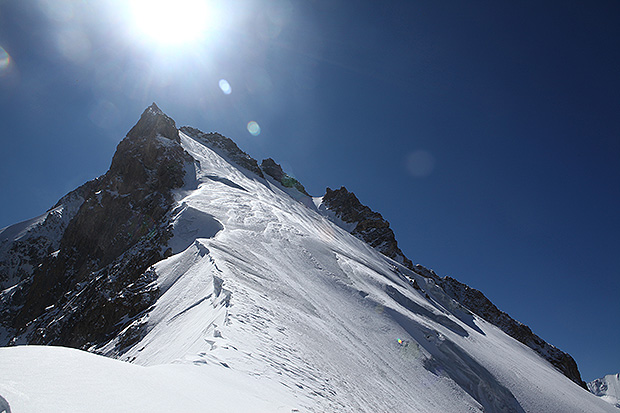
The North Ridge of Dykh-Tau. Contemporary photograph by Alexey Trubachev
The party remained on the summit only briefly. A strong, bitterly cold wind was blowing, and clouds were beginning to gather.
The descent to camp took considerably longer than expected, as they had to negotiate steep, difficult and entirely unfamiliar rocks in order to bypass the icefall. The route they had used to avoid the icefall on the previous day was impossible to follow in darkness.
On the descent, they reached the depression in the North Ridge at 6:00 p.m. and their bivouac site at 3,600 metres at 10:45 p.m.
The ascent and return to their high camp at 3,600 metres had taken exactly 18 hours.
On August 21, the party descended to base camp at the edge of the Bezengi Glacier.
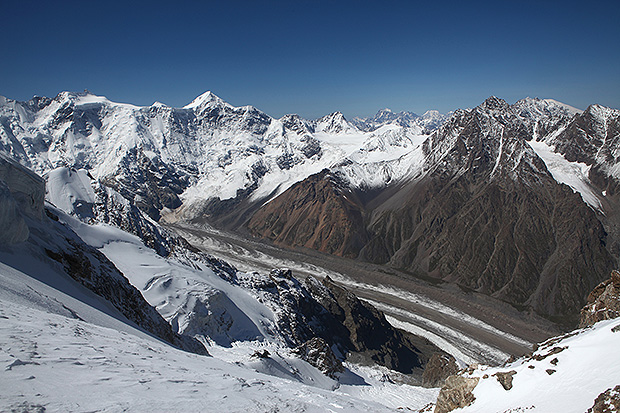
Descending from the Misses–Dykh Col after the ascent of Dykh-Tau. Contemporary photograph by Alexey Trubachev
--------------------------------
On the whole, the account of the first ascent of Dykh-Tau's North Ridge reads almost like the report of a routine climb — if we disregard the circumstances of a mountaineering expedition in a region of the Caucasus that was extraordinarily remote and difficult to reach at the time.
Yet the pace of the ascent already tells us something remarkable about the extraordinary strength of this team: two attempts on an unknown route, separated by only three days. It seems that their technically demanding climb to 4,880 metres had merely served as a warm-up.
The successful attempt speaks volumes about their physical condition as well. Today, the overwhelming majority of parties climbing this route make an intermediate bivouac at approximately 4,800 metres. But these pioneers climbed Dykh-Tau and returned to their camp at 3,600 metres in just 18 hours — along an unknown route, without weather forecasts, radio communications, rescue helicopters or any of the other blessings of modern civilisation.
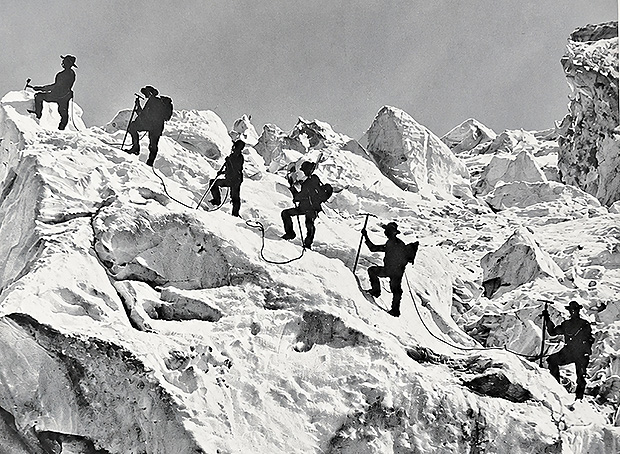
A party of mountaineers crossing a glacier in the Swiss Alps, 1890
And this is where the story becomes truly unbelievable. Even today, with all the advances in mountaineering technology, lightweight and practical equipment, climbing tactics, communications and safety systems, trying to imagine what the British party did next stretches the imagination beyond the limits of reality.
-----------------------------------
But let us return to 1888.
Just four days after descending from Dykh-Tau, Cockin's expedition was back on the mountain. Following the pioneering ascent of Dykh-Tau's North Ridge, the composition of the party gradually changed. Holder and Woolley later returned to England after climbing Salynan-Bashi, while Cockin continued his ascents with Almer and Roth.
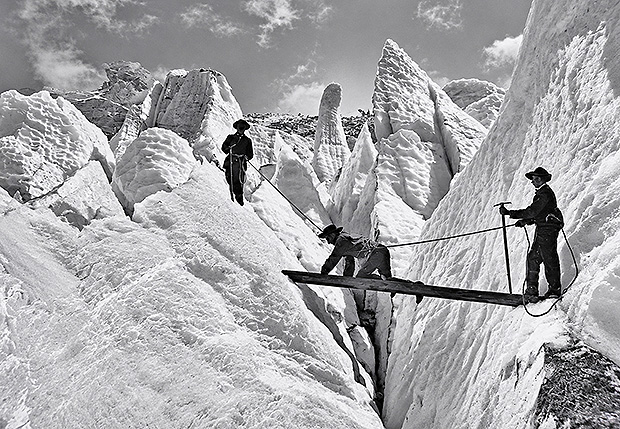
Two Swiss mountain guides belaying a client in an icefall, 1886
Incidentally, Dykh-Tau stands apart from the subsequent achievements of Cockin's party in one rather curious respect.
Before beginning their ascent, the climbers learned from a local inhabitant that someone had recently beaten them to the summit: on July 24, 1888, Albert Mummery and the Swiss guide Heinrich Zurfluh had made the first ascent of Dykh-Tau from the southwest.
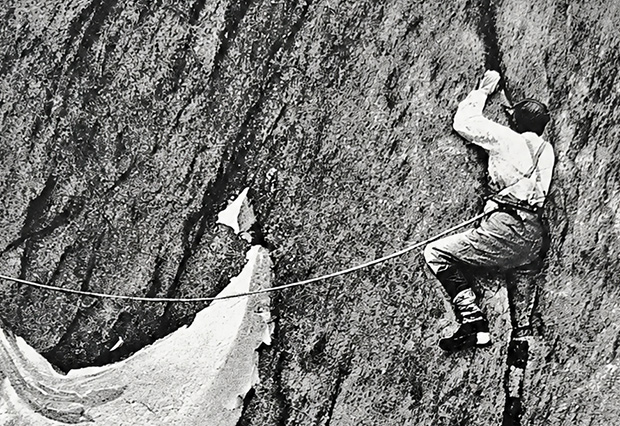
Albert Mummery negotiating a steep rock section during an ascent of the Grépon in the French Alps, 1892
And when Cockin's party reached the summit from the north on August 20, they found Mummery's summit cairn — final confirmation that they had failed to become the first men to stand on Dykh-Tau. But they had achieved the first ascent of its North Ridge.
The brilliant series of climbs that followed, however, consisted of genuine first ascents.
-----------------------------------
Five First Ascents of Difficult Peaks in Five Weeks
August 24, 1888 — Katyn-Tau, from the Bezengi Wall: first ascent
September 3, 1888 — Salynan-Bashi: first ascent
September 7, 1888 — Shkhara, via the Northeast Ridge: first ascent
September 12, 1888 — Eastern Jangi-Tau: first ascent
September 28, 1888 — North Ushba: first ascent
Even in the great age of pioneering mountaineering, such a concentration of difficult ascents within a few short weeks was exceptional. The entire series was completed without a single fatality or serious accident.
But the most astonishing part of this story is not even what I have already described.
The most fantastic fact — almost impossible to comprehend — is that the British members of this legendary expedition to the most formidable mountains of the Caucasus were not professional mountaineers.
----------------------------------
Who Were These Heroes?
They were not professionals. In fact, professional mountaineering in the modern sense barely existed at the time. The mountains did not earn them a living.
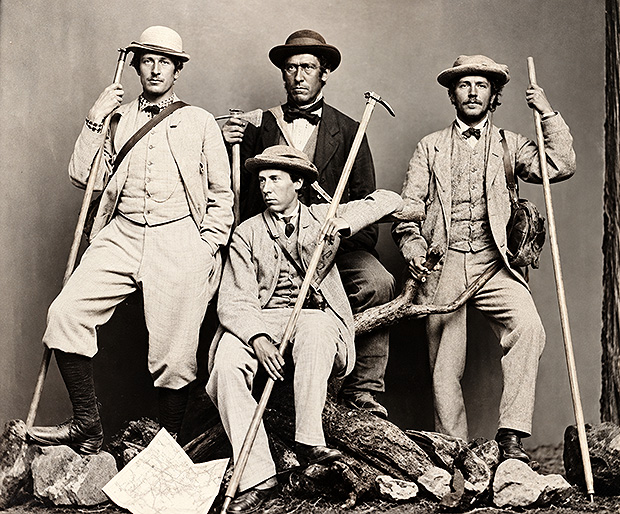
Members of the 1888 Caucasus expedition. At first glance, perfectly ordinary people
They earned the money for their journeys themselves, organised their own expeditions and travelled to explore unknown summits on their own initiative.
Yet although they were amateurs, they were certainly no dilettantes. In terms of ability and experience, they ranked among the strongest mountaineers of their generation.
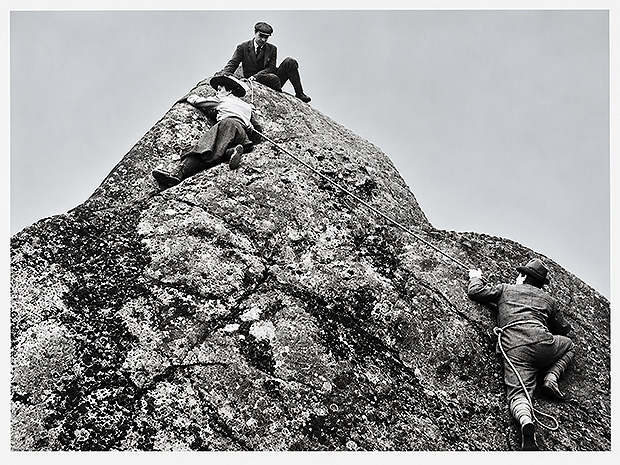
Nineteenth-century London high society was by no means unfamiliar with mountaineering and rock climbing
The British core of the party was not made up of professional athletes. John Cockin had studied law and been called to the Bar. Henry Holder was a university employee and former clergyman. Hermann Woolley was a pharmaceutical industrialist.
An interesting detail: despite photography having become a familiar part of everyday life by that time, I have so far been unable to find a single photographic portrait of John Cockin on the internet.
It is yet another small mystery surrounding the extraordinary expedition of 1888.
------------------------------------------
The party also included two Swiss mountaineers — Ulrich Almer and Christian Roth.
They were professional mountain guides. But on climbs of this level of difficulty, one cannot compensate for a lack of personal ability by relying on someone else's experience. Every member of the team must be equally fit, and everyone must work together, carrying out their responsibilities on equal terms.
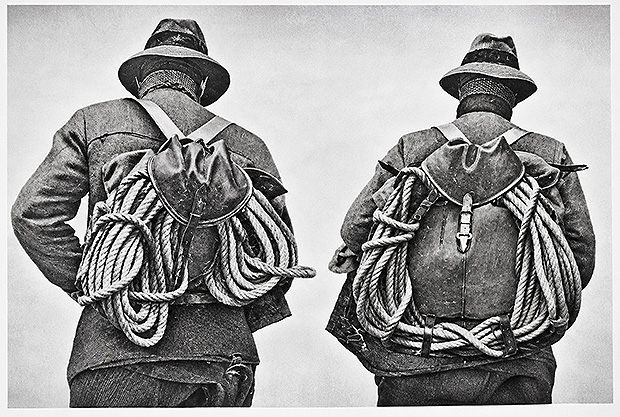
With equipment like this, Cockin's party climbed some of the most difficult mountains in the Caucasus
The presence of Swiss guides did not turn this expedition into a professional sporting enterprise. It remained a desperately adventurous and extraordinarily ambitious attempt by a group of passionate men to penetrate the heart of wild, unknown, unexplored mountains.
And these were not twenty-year-old athletes: the British members of the expedition were between 37 and 42 years old.
How they managed to achieve such success is a secret they took with them to their graves.
Perhaps, setting out into the complete unknown, they simply had no idea what grades future generations would assign to the mountains they were climbing. After all, they were the first. There was nobody to tell them just how difficult their achievements were supposed to be. Quite simply, nobody had ever done these things before.
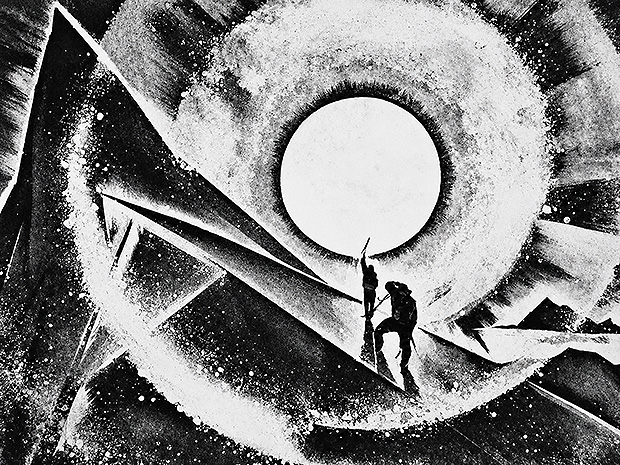
Photograph of a painting displayed in the Khergiani Museum in Mestia, Svaneti. Artist unknown
Unaffected by other people's assessments, they simply kept moving towards the summit, putting all their determination to succeed into every step… And relying on nobody but themselves.
-----------------------------------
After his extraordinary series of ascents in the Caucasus, John Garforth Cockin continued climbing mountains for another twelve years. In July 1900, at the age of 53, he was killed on the Weisshorn in the Swiss Alps. Until the very end, the mountains never became his profession. But they remained his life.
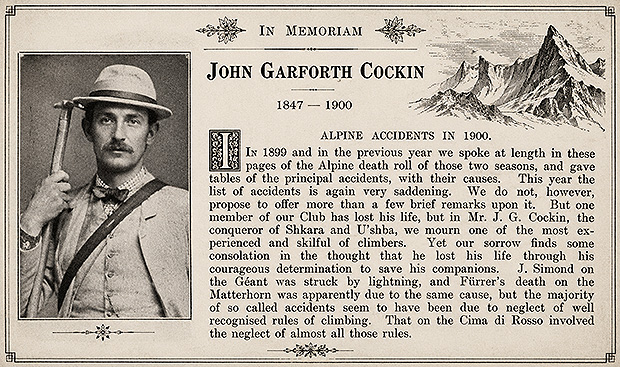
John Garforth Cockin (1847–1900)
Alpine Accidents in 1900
In 1899, and again in the preceding year, we devoted considerable space in these pages to the roll of those who had lost their lives in the Alps during those two seasons, providing tables of the principal accidents and their causes.
This year's list of accidents is once again deeply saddening. We do not, however, intend to offer more than a few brief observations upon it.
Our Club has lost one of its members. In Mr J. G. Cockin, the conqueror of Shkhara and Ushba, we mourn one of the most experienced and skilful mountaineers.
Yet our sorrow is tempered somewhat by the knowledge that he lost his life through his courageous determination to save his companions.
J. Simond was struck by lightning on the Géant, and Führer's death on the Matterhorn was apparently due to the same cause. Most of the so-called accidents, however, seem to have resulted from a disregard of the well-established rules of mountaineering.
On the Cima di Rosso, almost every one of those rules was neglected.
-----------------------------
Text and contemporary photographs by Alexey Trubachev
Your guide to mountaineering, ice climbing and rock climbing
MCS EDIT 2026
Our Principles

AlexClimb Rule #1 - Safety First
From the very beginning of our activity, here nearly 16 years, the first Principle of work of School of mountaineering and rock-climbing of MCS AlexClimb is the Safety Priority. On the basis of this Principle all process of training is based, all programs and rounds are developed and carried out only within this main principle. We consider that at professional approach to development of programs, at personal discipline and correctly put motivation - occupations by mountaineering and rock-climbing are COMPLETELY safe. And from the return - all troubles and accidents in our sport come from nonprofessionalism, from ignorance or neglect by elementary standards of safety, from irrational motivation, from revaluation of own forces and opportunities. All these prerequisites we COMPLETELY EXCLUDE in our work - ours Rock-climbing, Ice climbing and Mountaineering are based on one Principle - the Safety Priority. In rock-climbing, mountaineering and ice climbing, the Priority of Safety of MCS AlexClimb-is your personal security and comfort irrespective of, than we are engaged - we train muscles and we work technology of the movement in the sports hall and on the rock climbing wall, we make the way through snowstorm to top or we relax on golden sand of the Caribbean beach after hot day of trainings on rocks. The Safety priority - the main credo of School of mountaineering and rock-climbing of MCS AlexClimb.

AlexClimb Rule #2 - Leave No Trace
Closely interacting with Nature, working with the active programs in mountains, woods, lakes and rivers, we perfectly understand the importance of carefull and respectfull bahavior towards the Nature, for its resources. From the very beginning of our outdoor-activity we adopted rules of Leave No Trace technique - the standard of behavior of the person accepted in all the civilized world in relation to environment and especially - to the wild nature. After all on the relation of people to the nature near which they exist, itself can draw dalekoidushchy conclusions on the relation of these people to... Where and as we didn't travel - we don't reserve any garbage, we try to reduce whenever possible our influence on environment to a minimum. We clear earlier zagryazyonny tourist parking of the left garbage, we take out and we take out to utilization places that to us other people left there. We consider that only thus, at personal individual consciousness of each citizen, each tourist, climber or autotraveller, we will be able to keep the nature surrounding us in its state, natural, suitable for life, - in it pledge of the healthy future for ourselves and our children.
