





About us
- Project Overview
- Concept
- Safe mountain climbing
- Safe rock climbing
- Gift sertificates
- Courses
- Feedback
-
Articles
-
Lirics, enigmas and misterios of mountain climbing
- Climbing psychology
- Kamchatka sea lions
- Ten best mountains of the world
- Machu Picchu Mystery
- Menorca - the mystery of the Talaiots
- Russian climbing reality
- The Camel
- Dyatlov group tragedy - version with no mystics
- Abandoned lighthouse
- Gaucho Argentina
- Horses and mountains
- Akershus Fortress
- Bergen, Norway
- Black Ufany forest
- On the benefits of evening walks
- The Child
- Bezengi - the arena of the Death: The Mizhirgi Tragedy
- Bezengi Arena of Death: Tragedy on Dykh-Tau
- Dykh-Tau – History of the First Ascent (1888)
- The Pilot's ring
-
Stories about alpine climbing trips
- South Ushba via 3 buttress
- Ojos del Salado Arg side 2023
- Khan Tengri Edge of risk
- Dykh Tau and Bezengi 2023
- Mount Belukha - the Princess of Altai
- Climbing Alpamayo 2023
- Season 2023 completed
- Season 2023 specifics
- Climbing Monblan 2022
- Lifeless Sierra smiles
- Cerro Torre 50
- Siula Grande
- Climbing Kazbek. Georgia
- Ushba mountain beach
- North Ushba climb
- Morocco, Toubkal climbing
- The Life of the Valley of Sun
- Ushba. Forbidden Mountain
- Peak Lenin Climb
- Kilimanjaro climb
- Elbrus. Today, yesterday and tomorrow
- Mount Kenya climb
- Wind, Rocks and South Cross
- Kluchevskaya Sopka climb
- Peru climbing
- Touching the Legend
- Solo climb of Matterhorn
- Elbrus. Interview with rescuer
- Elbrus - the live legend
- Tian Shan, Peak Komsomol climb
- Khan Tnegri from the North
- International Ushba climb 2002
- Ushba 2002. Author Sergey Zabrodin
- Svanetia, Caucasus from the South
- Climbing Matterhorn - first article
- Climbing Belukha, Altay
-
Rockclimbing stories
- Menorca rockclimbing
- Tenerife rockclimbing
- Climbing in Mallorca January 2023
- Montserrat
- Majorca rockclimbing report 2014
- Rockclimbing in Peru - Huaraz 2023
- Mallorca rockclimbing December 2023
- Brazil rockclimbing
- Canary Islands and Tenerife
- Georgia Rockcimbing
- Madagascar rockclimbing
- Rockclimbing trip to Kalymnos, Autumn 2014
- Rockclimbing trip to Kalymnos, Spring 2014
- Rockclimbimg in Cuba
- Quadras or the architecture of the gods
- Rockcliming Armenia
- Cuba far away
- Crimea winter Rockclimbing
- Gear reviews, repairs, fails
- Iceclimbing trip stories
-
Lirics, enigmas and misterios of mountain climbing
- Codex of Mountain Guide
Morocco, Toubkal climbing
English version of the text for mobile device
Versión del texto en español para dispositivos móviles
MCS AlexClimb Mount Toubkal Climbing Program
This story isn't about conquering the mountain—it's about friendship with it, the joy of movement, and the purity of emotions.
We were incredibly lucky with the weather... The same time I felt that definitely I am going to have a good relationship with this mountain.
When we arrived to Imlil, everything looked hopelessly gloomy; the mountain wasn't even visible among the thick grey clouds—it was snowing and blowing fiercely in the high.

Bad weather hung over the Atlas Mountains
I have my own little ritual—almost a superstition. Approaching the mountain I plan to climb, I raise my hand, palm open, toward the summit and listen to my sensations: warmth means success; cold means the mountain might turn me away...

Toubkal's summit is covered in fresh snow and looks uninviting
Having in this way greeted the gloomy outline of Toubkal's rocky peak, I felt a gentle breeze of warmth. Considering this a good sign, I joked to my climbing partner, "You'll see, the weather is going clear up in a couple of days!"
It wasn't for looking at the bad weather that we travelled so far; stunning views from the summit are a must have. My friend shook his head sceptically.
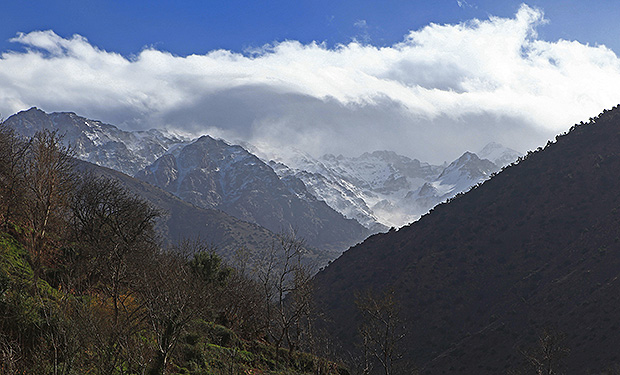
The bad weather had passed, and the blue sky was returning
The joke proved prophetic. The weather was clearly improving, and by the time we began the climb, the clouds had cleared completely, even the wind had died down.
We left Imlil quite late; the sun was already high and shining directly into our faces, making it difficult to discern the details of the towering rock mass ahead.

Starting the trek to the Summit of Toubkal
The scenery along the road to the Toubkal mountaineering hut was no different from the dusty, monochromatic views of reddish villages and rocky, sun-baked slopes we'd become accustomed to over the past few days.
The only difference was that today we began to encounter occasional groups of people dressed differently from the local Berbers in their hooded robes.

Everything was delighted by the long-awaited sunshine
Colorful jackets and trekking poles clearly indicated their owners' hobbies as hiking.
The general mood of the tourists we met was upbeat. It was understandable—after a long wait, the weather had finally cleared up. Judging by the satisfied faces, it was clear that most of them had successfully climbed Mount Toubkal.
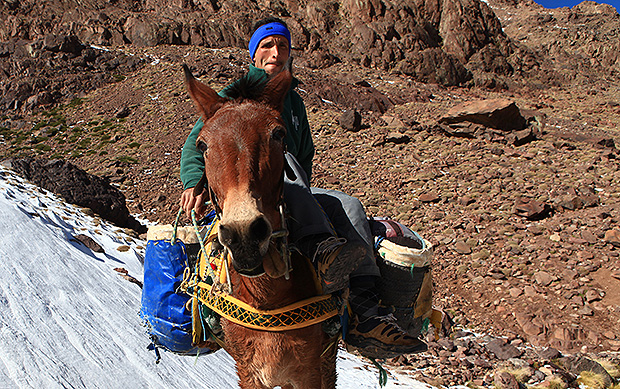
Climbing Mount Toubkal, Morocco
By the way, I finally understood my first impressions of Imlil. For some reason, this village seemed completely different from those we had seen along the way.
Imlil is a brighter and more positive place, for no apparent reason... Looks like any other, only slightly larger.
As we walked the straight valley from Imlil to the foot of Mount Toubkal, I had time to reflect on this.
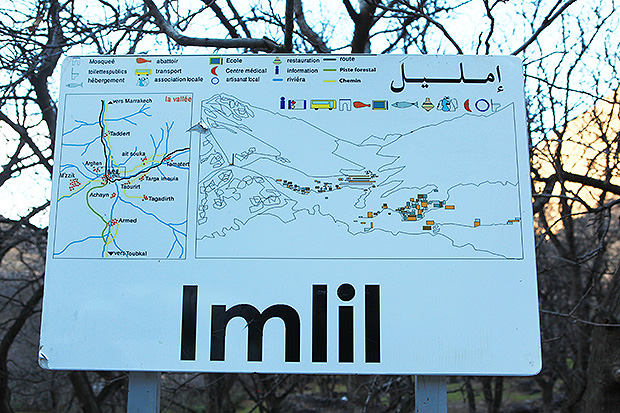
Imlil is the starting point for the Mount Toubkal ascent
Imlil is a place where people come, inspired by the goal of reaching the summit, full of expectations and hopes, and leave feeling enriched.
The climbers leave a little bit of joy from their fulfilled hopes in the atmosphere of this place, making it more positive and emotionally pure.
Incidentally, I've long noticed that a similar mood is characteristic of places located where people begin their journey to the mountain peaks—where they come into contact with the mountain elements. It was interesting to find familiar notes in the atmosphere of a new place. At my definition - Imlil is a place of joyful anticipation.

Imlil, Morocco
The weather was shining bright. The sky and sparkling snow. A very pure blue above and a very pure white below.
I need to visit the mountains more often to remember the purity and depth of these colours—it's impossible to experience this feeling on the plains, much less in the city.
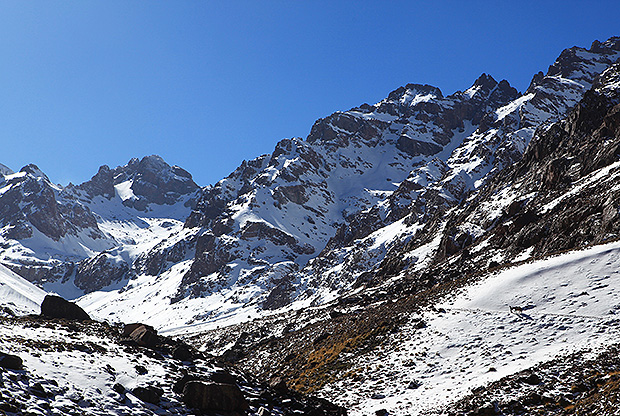
A wonderful morning after a long spell of bad weather
Today the mountains revealed their full beauty. Such beauty isn't easy to see—you have to be able to feel it - that is the trick: beauty isn't always so easy to feel and understand.
Beauty comes in many forms. It can be bright and intrusive, or the opposite. It can be modest and unnoticeable. Or it can be so deeply hidden within itself that you won't notice it until it gets used to you and in some moment unexpectedly reveals itself.
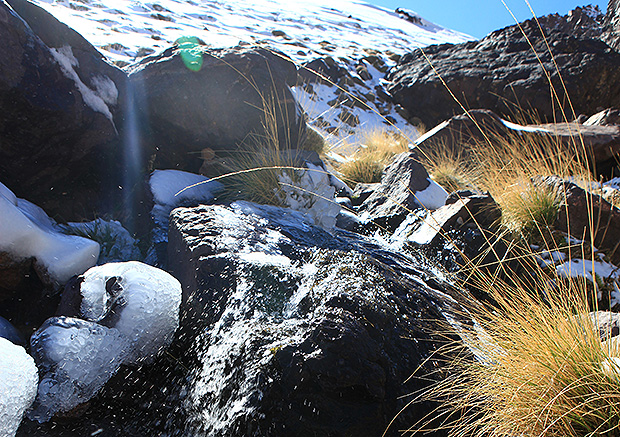
In bad weather, the mountains frown; in good weather, they smile
It would seem that these mountains lack brightness, no sharpness of form, or any particular variety of relief. And at first glance, the Atlas Mountains don't seem beautiful.
In various corners of the world, I've seen far more heartbreaking mountain landscapes... But there are no mountains in the world which are not beautiful - there are blind people. The chance to see this for myself got presented immediately, as soon as the snow-capped peaks pierced the dazzling blue sky.
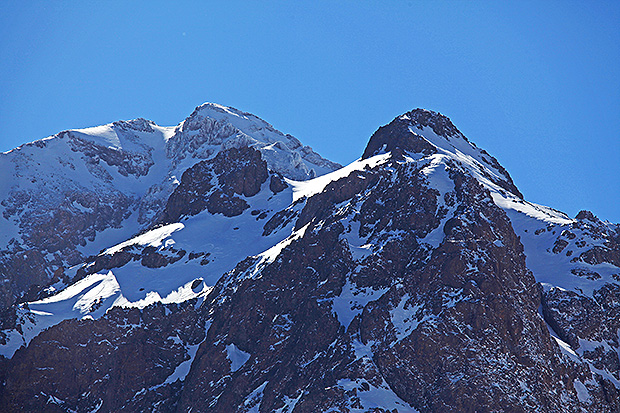
Mount Toubkal looks festive after a snowfall
How can one describe the pleasure of movement, the steeply ascending trail, the crystal-clear water in the tinkling stream, and the mountain air, faintly scented with ozone?
We gained 1,300 meters of altitude surprisingly quickly, then the trail became covered in snow and desperately slippery. Even the marks of someone´s crampons were visible in the packed snow—some people were descending using mountaineering gear.
The donkey carrying our luggage refused to go any further—its hooves were slipping. It´s owner, quite rightly, got concerned about the safety of his four-legged belonging.
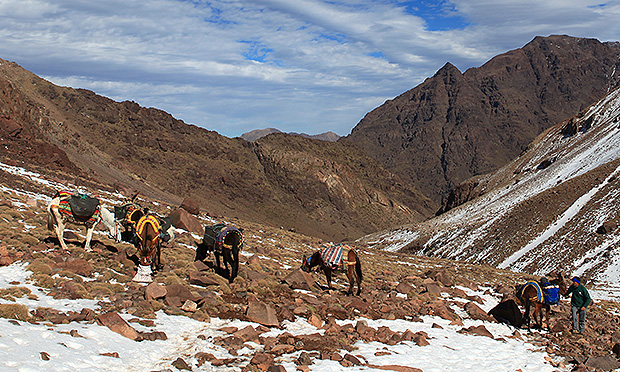
The donkey helped us to carry the load almost to the foot of Mount Toubkal, but refused to walk in the snow
Ahead, beyond the snowdrifts, a strange stone building was visible, inhospitably black with sharp square corners.
It didn't take much effort to guess that this was our destination for the day – the Toubkal Mountain hut, located at an altitude of 3,207 meters at the very foot of the mountain.
It was about an hour's walk to the hut, and with a sigh, I shouldered my backpack. The donkey also did a sigh, but unlike me, it sighed with relief.
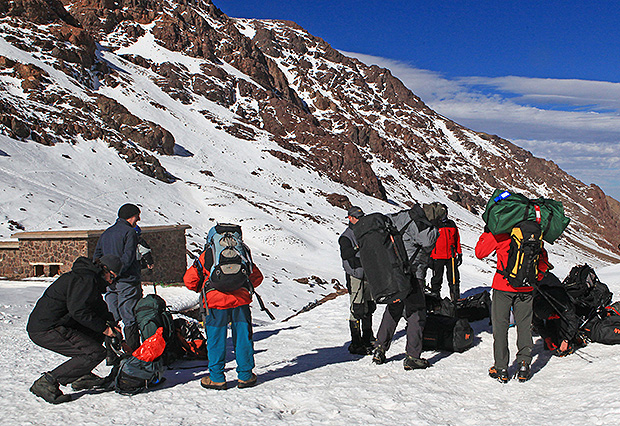
"Now we are going to ride tourist backs" cried the backpacks, as they switch their transportation mode.
At close distance, the hut no longer looked ominous, but rather resembled something relatively cozy and smelling deliciously of cooking food.
The sign next to the entrance dispelled any remaining doubts. How many times had I spent the night in such houses, solidly built from enormous boulders, as strong and terribly cold inside as medieval castles?
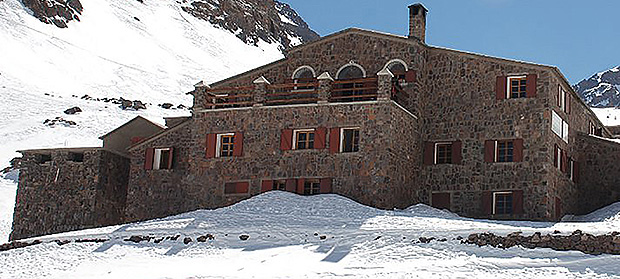
The Mouflon Refuge at the Foot of Mount Toubkal
The culture of building these mountain huts originated in the Alps in the 18th century, and now, along with the growing popularity of mountaineering, it has spread throughout the world. Similar huts are scattered throughout the depths of the Peruvian Andes, where many of them were built by the Italians.
Here, at the foot of Toubkal, we discovered a typical example of French mountaineering design. Everything is thoughtfully worked – sturdy doors, small windows, nice dining room, bunk beds in the bedrooms, and a well-equipped communal kitchen.
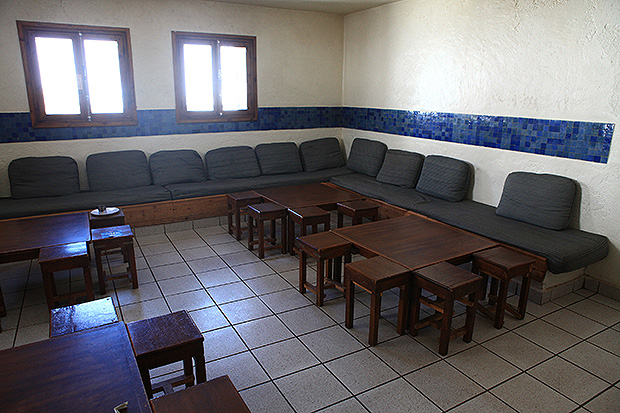
The spacious dining room at the Mouflon Refuge of Mount Toubkal
The kitchen was full of sizzling and frying, the aromas wafting through the hut's rooms, causing stomach discomfort.
As my partner began snoring on the sofa after a delicious and hearty lunch, an unlucky for him idea struck me.
It was only 3 PM, at least three hours left until sunset. Why not make good use of this time and go for a walk?
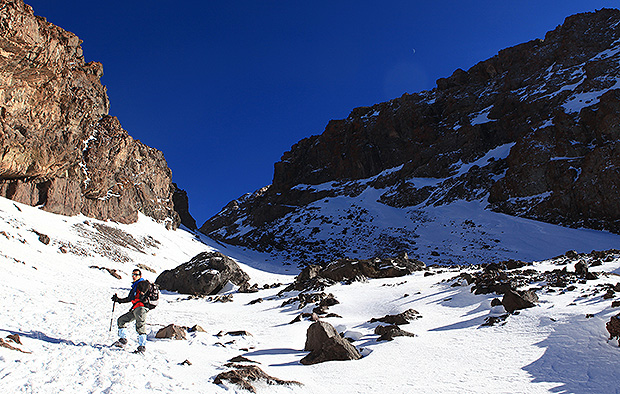
Three hours before dark, we set out to ascent Mount Toubkal
I knew well how such walks would end – there were 1,100 vertical meters left to the summit. This morning, we were gaining about 500 meters per hour along the trail to the refuge. With effort, we could easily reach the summit in three hours and even make it down before dark.
The eyes of my awakened partner were sad when I told him of my plans. But he generously declined the offer to stay and wait for me in the hut.
Of course, there wasn't much time to waste arguing and planning. We secured crampons to our boots, packed extra warm clothes, checked the batteries in our headlamps, grabbed our backpacks, and headed uphill.
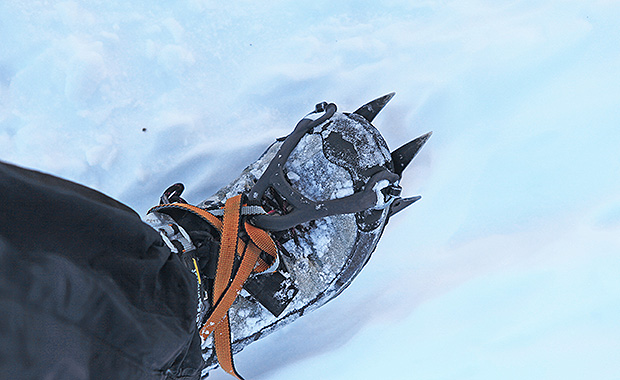
For climbing Mount Toubkal, we needed only crampons and trekking poles
The trail up the slope was clearly visible on the wind-packed snow, which was as dense as asphalt.
After traversing slightly to the right along the gentle slope, the trail led us to a small rocky ledge above the hut, then up into a wide chasm between two rock bastions.
The wind was strong down the slope, and the sun's rays no longer reached this side of the mountain. With the sun going down, it became noticeably colder, so we had to stop and put on our thoughtfully packed down jackets.
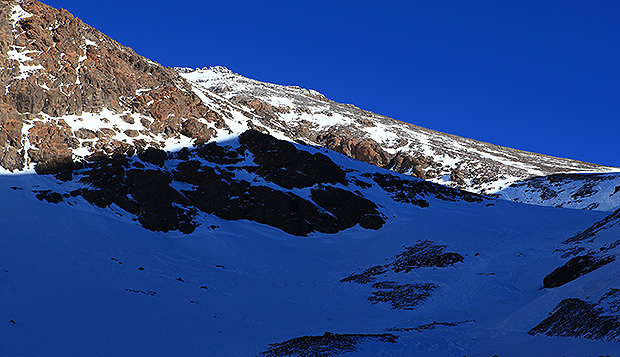
The sun was fading from the slope of Mount Toubkal much faster than we were ascending
It was the straightforward ascent. Slowly weaving switchbacks, we ascended the gentle, firn-covered slope. The snow was crunching under our crampons. Above us, at an incomprehensible distance, the way to the saddle was visible, presumably at an altitude of about 4000 meters.
From this section of the route, the summit of Mount Toubkal was not visible; it was hidden by the left rock bastion and, as it later turned out, by several other bends in the summit ridge.
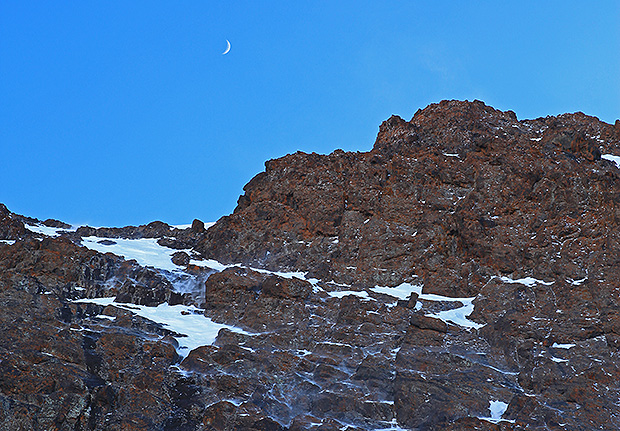
The wind was driving drifting snow across the rocky islands on the slope of Mount Toubkal
Nevertheless, the route was clear to understand – we were climbing, roughly guided by the time and the altimeter readings. The altitude was steadily approaching 4000 m.
Having climbed a small cirque surrounded by rock ridges, we turned right toward the saddle, it was still quite a distance from its visible depression.
From this point, the route via the left ridge seemed more optimal; it was slightly steeper, but seemed a shorter route to the summit. And just as importantly, the ridge was still sunny – a little warmth in the icy wind would have been more than welcome.
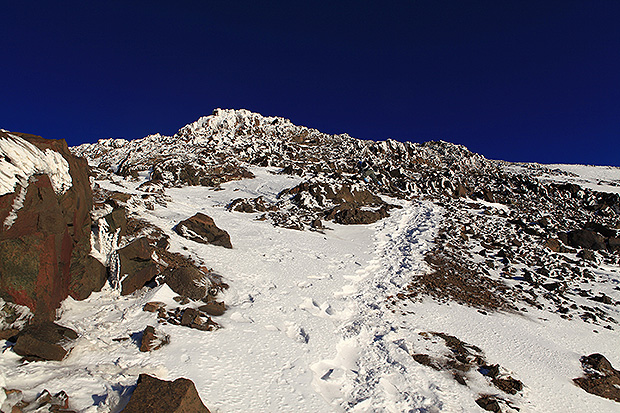
The summit of Mount Toubkal is out of sight, but it's already close
The cliffs at the top of the ridge were adorned with braids of snow, clung to them during a recent snowfall accompanied by a strong wind.
At the bottom of the ridge, the wind had already torn away these fragile decorations. Closer to the summit, likely due to the lower temperatures, the delicate beards of snow clung firmly to the cliffs and remained beautiful upon our arrival.
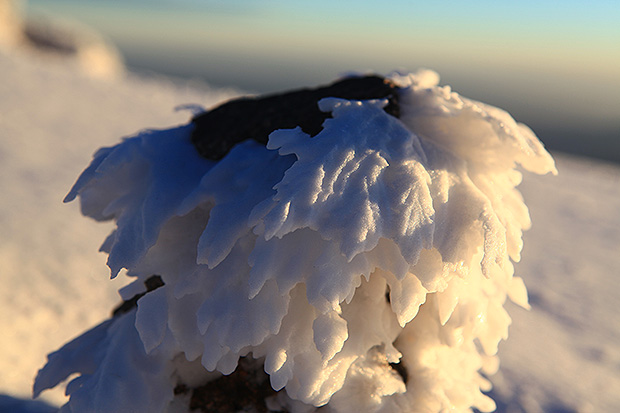
Feathers of snow clung to the cliffs of Mount Toubkal's summit ridge during the recent storm
The sun had already been close to the horizon, the snow and cliffs were gradually taking on a pinkish tint, and the east side of sky was beginning to turn blue.
Finally, a huge three-legged metal structure appeared behind the gently sloping snow dome, once installed at the summit for some geodetic purpose. The triangulation was covered in snow feathers and looked as decorated as a Christmas tree.
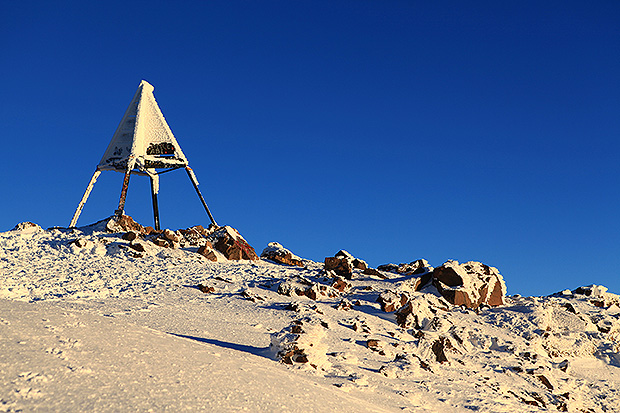
Here was our destination – the summit of Mount Toubkal
Oddly enough, there was barely a breath of wind at the summit, and the sunset was stunning in its grandeur and fluid play of colours.
There was no one at the summit – the strange desire to climb Mount Toubkal in the evening to enjoy the sunset usually doesn't occur to the normal climbers.
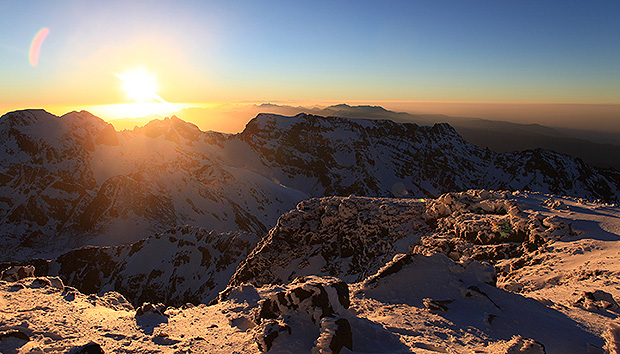
The beginning of a stunning show – the sunset over the Atlas Mountains from the summit of Mount Toubkal
Alone, at the summit of Mount Toubkal, we spent half an hour enjoying an indescribable sensation familiar to anyone who has ever consciously climbed a mountain. I call this feeling "the summit euphoria".

An incredible play of colours at sunset
Perhaps this state has its own physiological causes. For example, a strong sense of happiness can be the result of factors such as prolonged exertion in conditions of oxygen deficiency, sudden transition to a state of rest after exertion, achieving a long-awaited goal, the joy of victory, and so on.
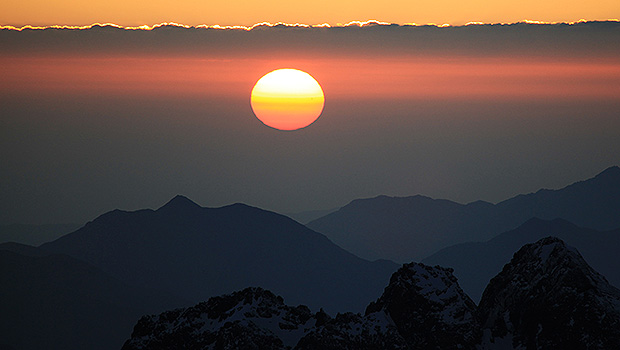
Sunset from the summit of Mount Toubkal
But if there's a rational explanation for those moments of indescribable happiness at the summit, I don't want to follow with it. It's enough to acknowledge that something happened when we were at the summit, that transcends the everyday emotional state.
This experience—half an hour in the pre-sunset silence at the summit of the Atlas Mountains—has become one of the most vivid and beautiful emotions I've experienced in the mountains.

The show's over, the curtain of night falls over the Atlas Mountains
...We descended quickly, almost running, periodically sinking knee-deep into the dense snow crust – the snow got quickly frozen and become brittle after sunset.
It soon became dark – the headlamps we'd thoughtfully brought came in handy. I hadn't imagined it could be so dark against the white snow, with a clear starry sky. Interestingly, the transition from the twilight to complete darkness occurred abruptly, in just a few minutes – as if someone had drawn the curtains.
The snow had turned black, making the descent uncomfortable; in the complete darkness, it was difficult even to judge the steepness of the slope for the next step.
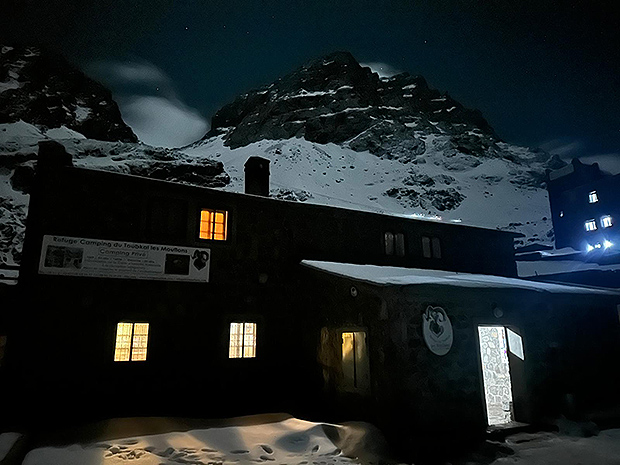
The welcoming lights of Mount Toubkal mountain hut
But the hut, with its illuminated windows, was already close. The entire descent in a straight line from the summit to the hut took no more than 40 minutes.
A wonderful dinner waited for us at the dining room in a friendly, warm company – a huge dish of traditional Berber couscous with meat and vegetables. For dessert, they brought fruit and sweet, strong tea, which, according to Bedouin tradition, we drunk from tiny glasses.
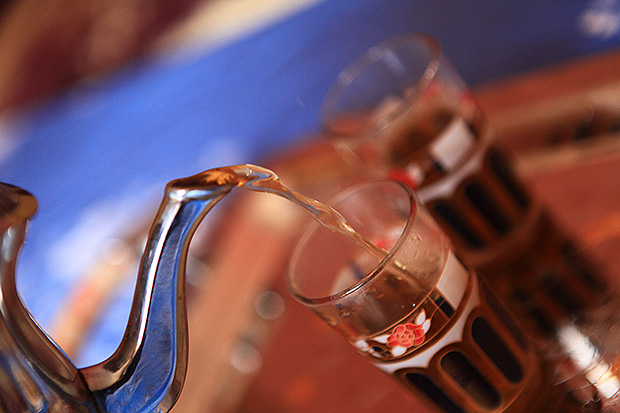
Traditional tea in Morocco is a true ritual
Author of the text, photographs, and programs in Morocco - Alex Trubachev
International mountain guide, rock climbing and ice climbing coach
MCS EDIT 2025
Our Principles

AlexClimb Rule #1 - Safety First
From the very beginning of our activity, here nearly 16 years, the first Principle of work of School of mountaineering and rock-climbing of MCS AlexClimb is the Safety Priority. On the basis of this Principle all process of training is based, all programs and rounds are developed and carried out only within this main principle. We consider that at professional approach to development of programs, at personal discipline and correctly put motivation - occupations by mountaineering and rock-climbing are COMPLETELY safe. And from the return - all troubles and accidents in our sport come from nonprofessionalism, from ignorance or neglect by elementary standards of safety, from irrational motivation, from revaluation of own forces and opportunities. All these prerequisites we COMPLETELY EXCLUDE in our work - ours Rock-climbing, Ice climbing and Mountaineering are based on one Principle - the Safety Priority. In rock-climbing, mountaineering and ice climbing, the Priority of Safety of MCS AlexClimb-is your personal security and comfort irrespective of, than we are engaged - we train muscles and we work technology of the movement in the sports hall and on the rock climbing wall, we make the way through snowstorm to top or we relax on golden sand of the Caribbean beach after hot day of trainings on rocks. The Safety priority - the main credo of School of mountaineering and rock-climbing of MCS AlexClimb.

AlexClimb Rule #2 - Leave No Trace
Closely interacting with Nature, working with the active programs in mountains, woods, lakes and rivers, we perfectly understand the importance of carefull and respectfull bahavior towards the Nature, for its resources. From the very beginning of our outdoor-activity we adopted rules of Leave No Trace technique - the standard of behavior of the person accepted in all the civilized world in relation to environment and especially - to the wild nature. After all on the relation of people to the nature near which they exist, itself can draw dalekoidushchy conclusions on the relation of these people to... Where and as we didn't travel - we don't reserve any garbage, we try to reduce whenever possible our influence on environment to a minimum. We clear earlier zagryazyonny tourist parking of the left garbage, we take out and we take out to utilization places that to us other people left there. We consider that only thus, at personal individual consciousness of each citizen, each tourist, climber or autotraveller, we will be able to keep the nature surrounding us in its state, natural, suitable for life, - in it pledge of the healthy future for ourselves and our children.
