





About us
- Project Overview
- Concept
- Safe mountain climbing
- Safe rock climbing
- Gift sertificates
- Courses
- Feedback
-
Articles
-
Lirics, enigmas and misterios of mountain climbing
- Climbing psychology
- Kamchatka sea lions
- Ten best mountains of the world
- Machu Picchu Mystery
- Menorca - the mystery of the Talaiots
- Russian climbing reality
- The Camel
- Dyatlov group tragedy - version with no mystics
- Abandoned lighthouse
- Gaucho Argentina
- Horses and mountains
- Akershus Fortress
- Bergen, Norway
- Black Ufany forest
- On the benefits of evening walks
- The Child
- Bezengi: The Mizhirgi Tragedy
- The Pilot's ring
-
Stories about alpine climbing trips
- South Ushba via 3 buttress
- Ojos del Salado Arg side 2023
- Khan Tengri Edge of risk
- Dykh Tau and Bezengi 2023
- Mount Belukha - the Princess of Altai
- Climbing Alpamayo 2023
- Season 2023 completed
- Season 2023 specifics
- Climbing Monblan 2022
- Lifeless Sierra smiles
- Cerro Torre 50
- Siula Grande
- Climbing Kazbek. Georgia
- Ushba mountain beach
- North Ushba climb
- Morocco, Toubkal climbing
- The Life of the Valley of Sun
- Ushba. Forbidden Mountain
- Peak Lenin Climb
- Kilimanjaro climb
- Elbrus. Today, yesterday and tomorrow
- Mount Kenya climb
- Wind, Rocks and South Cross
- Kluchevskaya Sopka climb
- Peru climbing
- Touching the Legend
- Solo climb of Matterhorn
- Elbrus. Interview with rescuer
- Elbrus - the live legend
- Tian Shan, Peak Komsomol climb
- Khan Tnegri from the North
- International Ushba climb 2002
- Ushba 2002. Author Sergey Zabrodin
- Svanetia, Caucasus from the South
- Climbing Matterhorn - first article
- Climbing Belukha, Altay
-
Rockclimbing stories
- Menorca rockclimbing
- Tenerife rockclimbing
- Climbing in Mallorca January 2023
- Montserrat
- Majorca rockclimbing report 2014
- Rockclimbing in Peru - Huaraz 2023
- Mallorca rockclimbing December 2023
- Brazil rockclimbing
- Canary Islands and Tenerife
- Georgia Rockcimbing
- Madagascar rockclimbing
- Rockclimbing trip to Kalymnos, Autumn 2014
- Rockclimbing trip to Kalymnos, Spring 2014
- Rockclimbimg in Cuba
- Quadras or the architecture of the gods
- Rockcliming Armenia
- Cuba far away
- Crimea winter Rockclimbing
- Gear reviews, repairs, fails
- Iceclimbing trip stories
-
Lirics, enigmas and misterios of mountain climbing
- Codex of Mountain Guide
Menorca - the mystery of the Talaiots
English version of the text for mobile device
Versión del texto en español para dispositivos móviles
MCS AlexClimb Programs in the Balearic Islands
There are many secrets in the past, the unravelling of which, I believe, can give us the answers to the most important questions we face today.
Here I will share an unexpected experience I had on the island of Menorca – a tiny oasis of peace and tranquillity amid the waves of the Mediterranean. But beneath the surface of the rural idyll, something completely different was hidden.
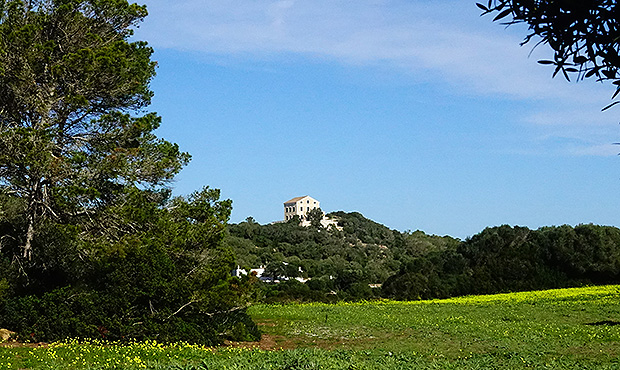
By its appearance, Menorca is just a rural idyll
Among the mysteries of antiquity that have long served as compass points for entire tourist destinations, any traveller will immediately name the Egyptian pyramids, Machu Picchu, Stonehenge, the Great Wall of China, and the sculptures of Easter Island.
But it's unlikely that anyone outside a small circle of scholars has heard of the mysteries of the astonishing Talayotic civilization, which centre, apparently, was on Menorca Island.
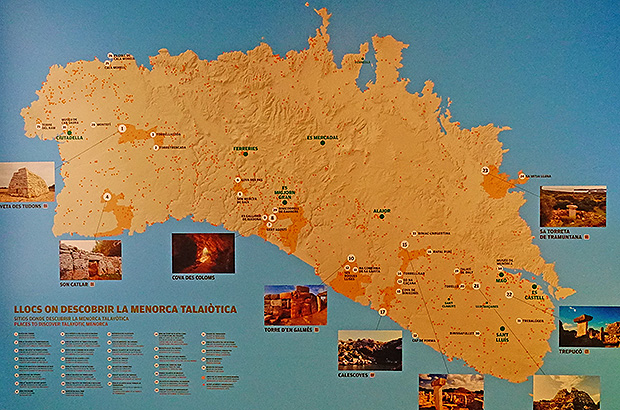
The small red dots on the map of Menorca indicate the locations of monuments from the Talayotic era
Officially, approximately 400 ancient stone monuments—talayots —are known and accessible to visitors on the island of Menorca.
The name Talayot comes from the Arab period in Spain—"tala" means watchtower in Arabic. However, these structures have no connection to the Arab period, nor to any other era, including the Roman Empire. The talaiots are older than any other known historical monuments, and are roughly estimated to be between 5,000 and 6,000 years old.
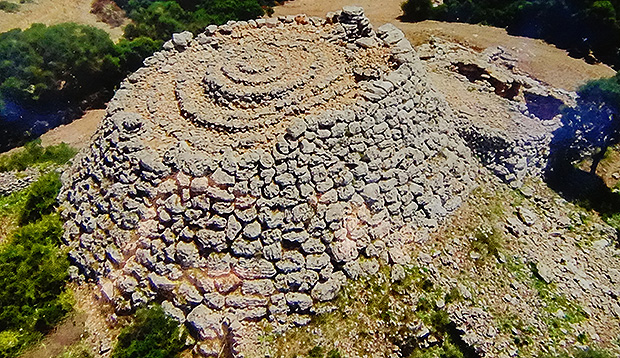
Talayot Coria Nu
A talayot is a megalithic structure in the form of a large stone mound, up to 15-20 meters high, composed of large stone blocks, sometimes weighing up to 70 tons. Some talaiots retain what appear to be stone gates or portals at their summits, accessed by a spiral staircase.
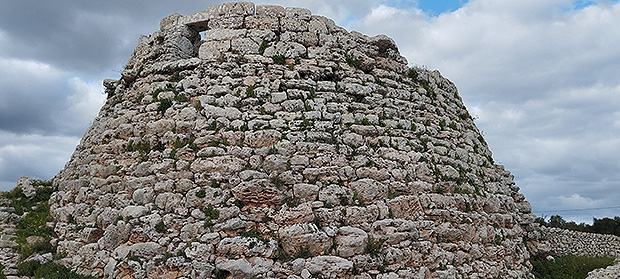
There are 397 known talaiots in Menorca
Besides talaiots, monuments from the talayotic era also include "navetas"—relatively small structures shaped like an upturned boat—and "taulas"— stone columns occasionally topped with enormous blocks—analogous to the Britain's Stonehenge. The only difference is that there are thousands of them in Menorca.
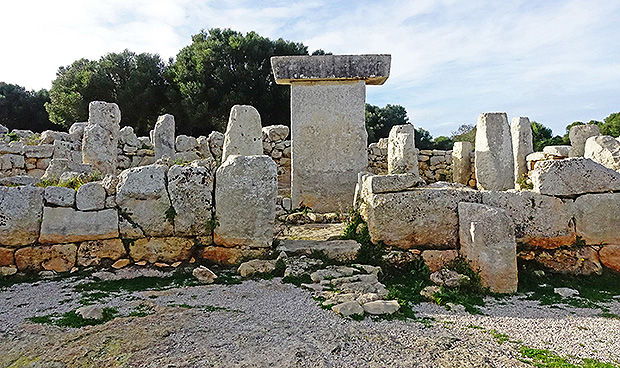
Taula - a circle of vertically placed stones
Besides the 397 Talayotic structures known on Menorca, at least as many more remain hidden in the dense vegetation and inaccessible areas of the island.
It could be said that Menorca, a small island measuring 40 by 20 kilometres, is completely covered in traces of some titanic ancient activity for which modern science has no explanation.
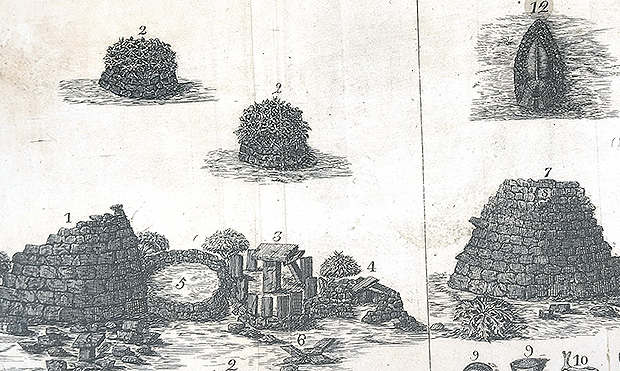
Talayotic structures in a 19th-century engraving in an archaeological almanac
Everything concerning the purpose, construction method, and use of the Talayotic structures is shrouded in mystery. Over 200 years of research, historians and archaeologists have failed to answer even the most basic questions about who, when, and why built these stone sculptures on the island.
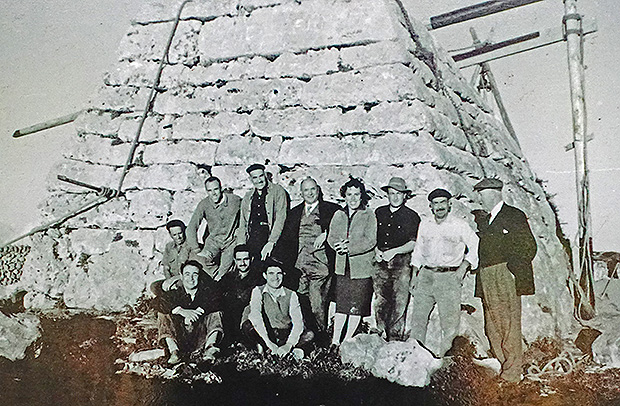
Since the late 19th century, many archaeological expeditions have unsuccessfully attempted to unravel the mystery of the talaiots.
No amount of imagination can connect these monumental structures with any economic necessity – they clearly had an entirely different meaning and significance.
Pileing these enormous stones on top of each other required colossal effort and time. But this work was done with such high quality that the result has survived the succession of many civilizations.
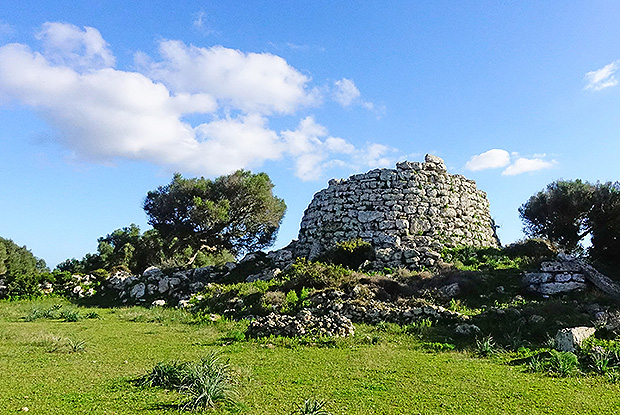
Cosmic Peace at the Foot of the Talayot
When the Roman Empire arrived to Menorca, approximately 2,000 years ago, these talayots were shrouded in the same impenetrable mystery of antiquity as they are today.
The thrifty Romans couldn't even adapt the talayots to their numerous needs and demands – these colossal structures were so impractical and useless... Even breaking them down for material was more expensive than taking new stone from the quarries!
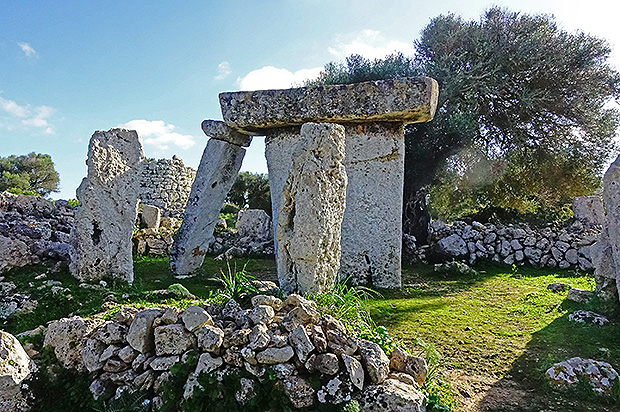
Why was it necessary to spend so much effort, and where could one get power for it?
When I finally found time to visit Menorca, the second largest of the Balearic Islands, I had no particular expectations for the trip.
Compared to neighbouring island Mallorca, where I spend a lot of time doing rock climbing, Menorca seemed like a godforsaken backwater. However, it had some interesting climbing areas worth exploring to diversify my collection of climbing locations.
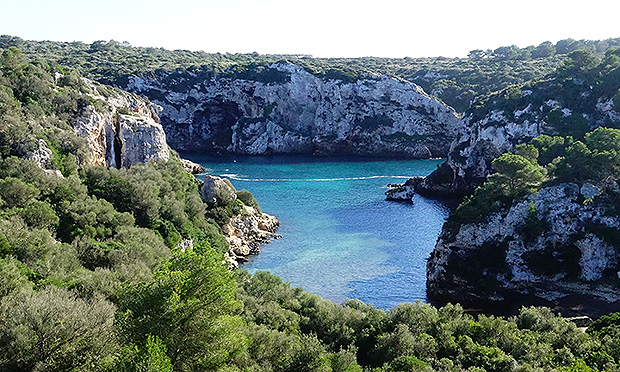
Rocks and sea – what more could a climber need?
Unexpectedly, my trip to Menorca turned out to be much more interesting than I expected – to say I was impressed would be an understatement. More accurately, I was stunned by the unique features of this small island.
Oddly enough, these features had nothing to do with my rock climbing.
Waking up at dawn, I realized that this brilliant winter day should be spent exploring the island of Menorca in a more diverse way than revisiting the rock climbing routes on the Cavalry Peninsula.
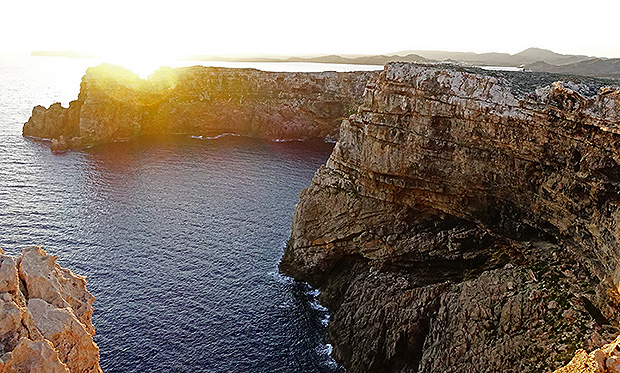
Sunrise on the Cavalier Peninsula, Menorca's premier climbing location
The weather was perfect for any type of walk – a bright, warm, and windless winter day delighted me with the vibrant colors in every detail of the landscape – the outlines of the gentle, emerald-green hills, the russet patches of rock, the yellow foam of the flower fields.
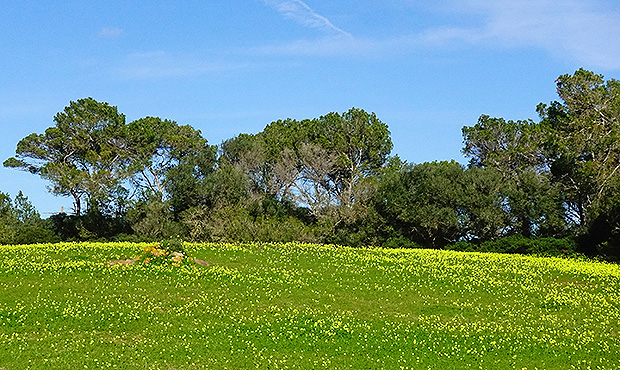
If I could choose paradise, I would choose this one
I had planned to spend the day exploring the labyrinth of ancient streets in the centre of Ciutadella, choosing gifts for my friends for the upcoming Christmas.
But as I drove along the fast and very beautiful highway toward Ciutadella, my plans suddenly changed.
The number of signs pointing to historical sites kept forcing me to put my foot on the brake pedal. Finally, I couldn't resist turning left toward the yet unknown name of Naveta de Tudons.
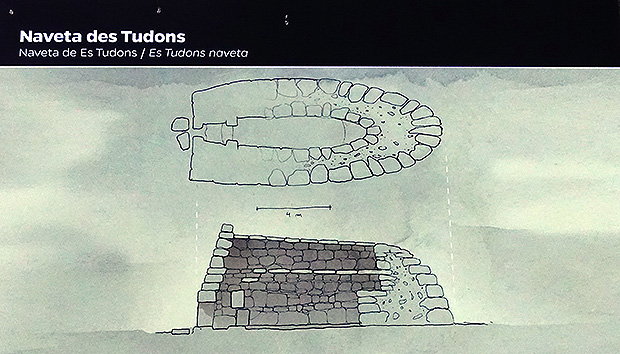
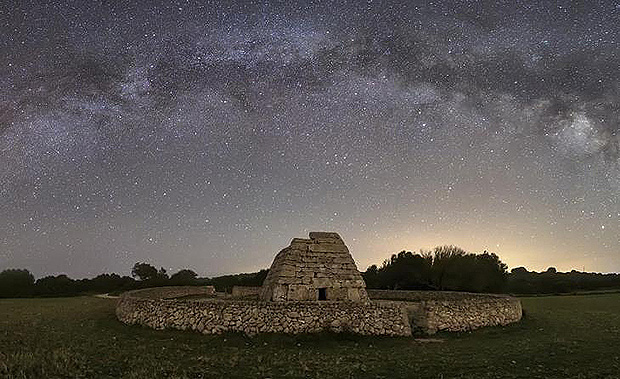
Naveta de Tudons
Literally a few minutes later, I realized I hadn't been mistaken – the sign depicted the very structure I'd long dreamed of seeing with my own eyes, though I just didn't know exactly where it was located.
Naveta de Tudons turned out to be Menorca's most famous, picture-postcard monument from the Talayotic period – the only monument well known outside the island.
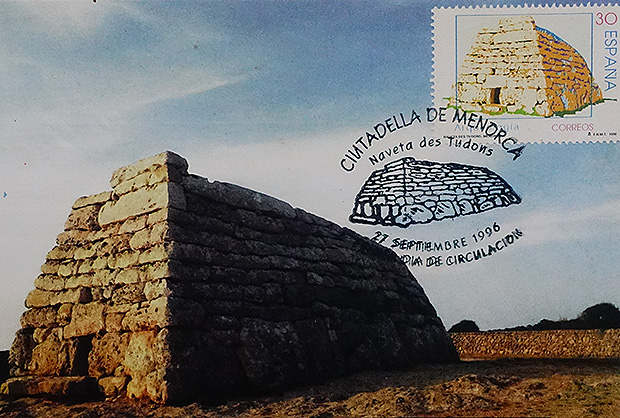
Postcard with stamp from the Spanish Post depicting Naveta de Tudons
A few facts about the discovery and attempts to study this artifact were presented on an information board at the entrance to the site.
From that same board, the origins of the name "naveta" became clear. The term originated in the 19th century, when archaeologists first noticed the strange cyclopean megaliths of Menorca.
Some of the mysterious structures resembled a boat lying upside down, with a small entrance at the "stern," a narrow interior, and walls over 1.5 meters thick. The word "boat" in Latin is "nave," - the word "navigation" comes from the same root. So, naveta means "boat" or "small ship."
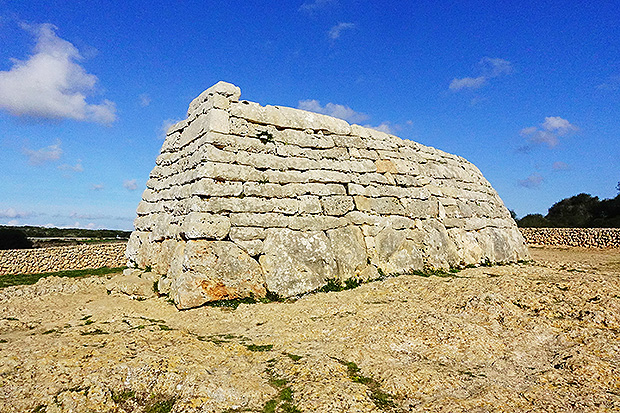
Naveta de Tudóns
The Naveta de Tudóns is the most famous of these structures in Menorca, the best-preserved, and utterly enigmatic, like all the monuments of that era.
The quantity of the navetas in Menorca is significantly smaller than the talayots, which may indicate a special significance for these relatively small structures.
The appearance of Naveta de Tudóns was striking in its perfectly finished forms and the exquisite fit of the large stone blocks—I have never seen such precision in the stonework on any talayot.
As with talayots, no kind of binding was used to secure the blocks during construction—the stones, tightly ground against each other, were held together only by their own weight.
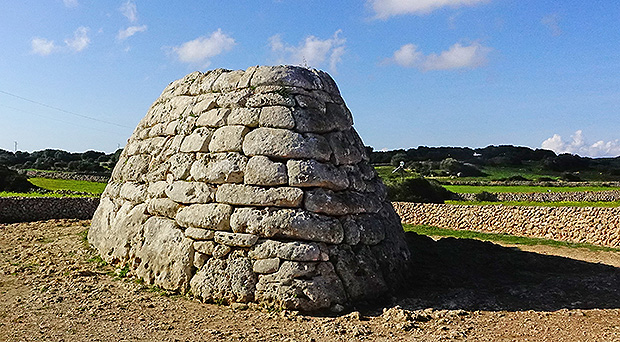
Naveta de Tudóns
Formally, researchers link the origin of the naveta to unknown funeral rituals, but this is only a hypothesis.
No archaeological evidence of the use of navetas for burials has been found. They could equally well have been sanctuaries, or even dwellings of some special creatures.
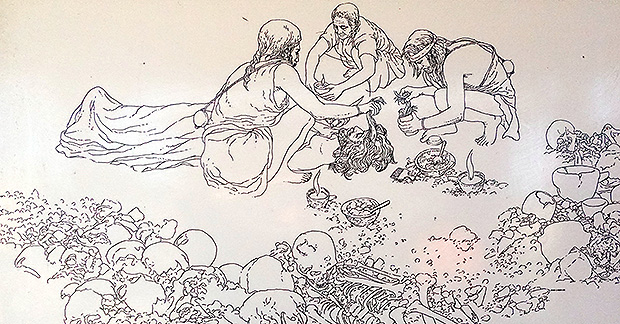
There is a theory that the navetas are connected to funeral rituals
The Naveta de Tudóns left me with a complex impression. Although the naveta is significantly smaller than any, even a small, talayot, it was clearly a particularly important structure for those who built it.
This importance is evidenced by the precision of the stone blocks, the perfect symmetry of their sides, and the architectural completeness. The silence of antiquity in this place carries a particularly deep, sacred meaning.
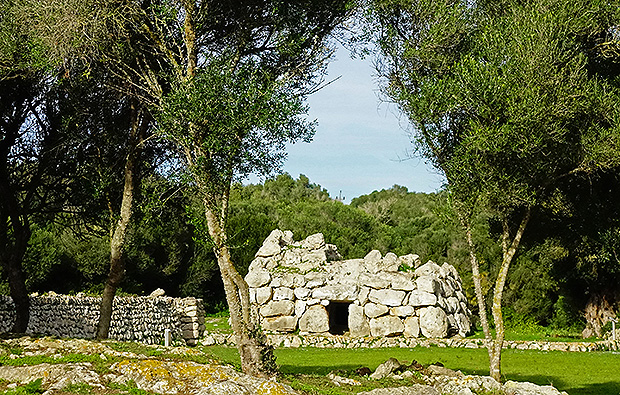
All the megalithic complexes of Menorca are completely different, in size, architecture, and the presence or absence of restoration efforts
They also differ in the nature of the sensations they evoke, among which the most perceptible is a peculiar emptiness—the silence of a gigantic gap in time separating me today from those who created these stone sculptures, linking us in one chain of history.
This chain conveys nothing—it is empty on the other end. Yet, it seems to me, may be there's something there, something very important to understand.
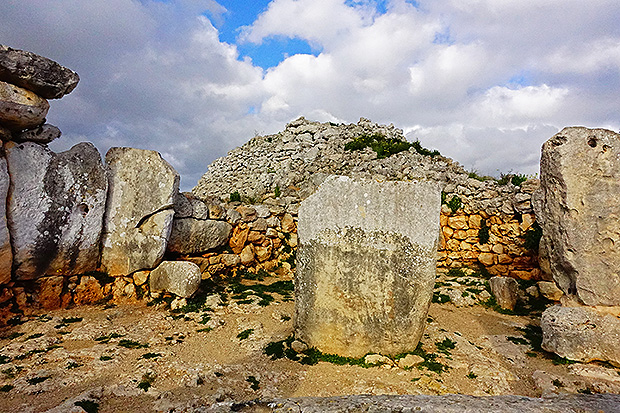
Silent Witnesses of a Very Distant Past
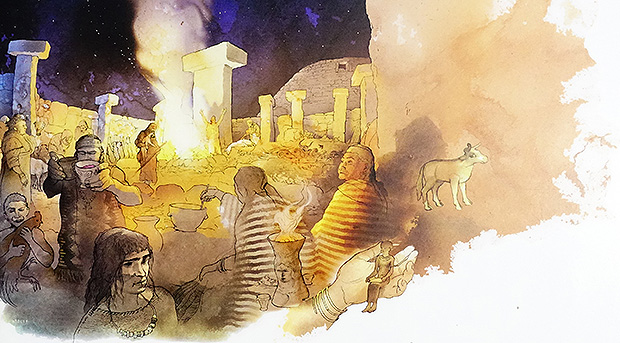
For the entertainment of tourists, information boards depicted contemporary artists' renderings of the Talayotic era.
The drawings show muscular, hairy men in animal skins dragging enormous stones on ropes and sitting around a blazing fire in the centre of the Taula stone circle, beneath overhanging stone blocks placed on vertical pillars… Incidentally, just to move a 50-ton stone block it requires the simultaneous effort of at least 1,000 people...
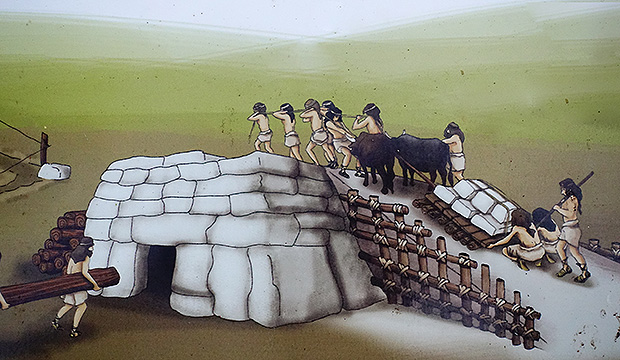
This is a modern artist vision of the construction of the talayot
It seems to me that these images bear no relation to the historical reality as it is shrouded in profound darkness. And, like any ancient history, lacks any romantic details in our concept of the romantic.
It is unknown what actually happened there, but it was almost certainly savage darkness, bestial rage, the short and terrible lives of people which severity we cannot even imagine today.
------------------------------
I can feel well the atmosphere of places. Having travelled a lot, I've learned to literally visualize a scene from the past, thanks to the atmosphere that somehow accompanies any place that has been in contact with people for a long time.
Colorful pictures of medieval life rise right before my eyes, palpable in the details of every turn of the narrow streets of ancient towns. Roman ruins also echo with ghostly images of ancient life...
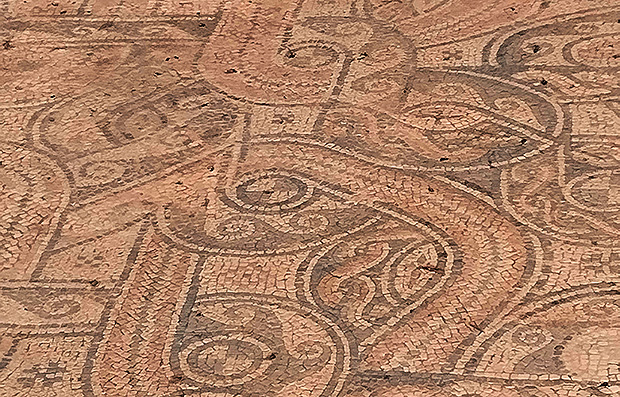
A preserved Roman mosaic on the floor of an ancient basilica in Menorca
Play of shadows, rustle of long-faded footsteps—all this can be discerned if you stay in silence, alone with the mass of centuries that have flown by.
But some places—for example, talayots—resound with a profound silence, a deep, mysterious darkness that sends shivers down your spine.
There must have been something in this darkness, and perhaps there's even a way to penetrate in it. But right now, my abilities are clearly not enough even for the first steps.
The Mystery of the Talayots of Menorca
Text and photographs by Alex Trubachev
Your guide to Spain and the Balearic Islands
MCS EDIT 2025
Our Principles

AlexClimb Rule #1 - Safety First
From the very beginning of our activity, here nearly 16 years, the first Principle of work of School of mountaineering and rock-climbing of MCS AlexClimb is the Safety Priority. On the basis of this Principle all process of training is based, all programs and rounds are developed and carried out only within this main principle. We consider that at professional approach to development of programs, at personal discipline and correctly put motivation - occupations by mountaineering and rock-climbing are COMPLETELY safe. And from the return - all troubles and accidents in our sport come from nonprofessionalism, from ignorance or neglect by elementary standards of safety, from irrational motivation, from revaluation of own forces and opportunities. All these prerequisites we COMPLETELY EXCLUDE in our work - ours Rock-climbing, Ice climbing and Mountaineering are based on one Principle - the Safety Priority. In rock-climbing, mountaineering and ice climbing, the Priority of Safety of MCS AlexClimb-is your personal security and comfort irrespective of, than we are engaged - we train muscles and we work technology of the movement in the sports hall and on the rock climbing wall, we make the way through snowstorm to top or we relax on golden sand of the Caribbean beach after hot day of trainings on rocks. The Safety priority - the main credo of School of mountaineering and rock-climbing of MCS AlexClimb.

AlexClimb Rule #2 - Leave No Trace
Closely interacting with Nature, working with the active programs in mountains, woods, lakes and rivers, we perfectly understand the importance of carefull and respectfull bahavior towards the Nature, for its resources. From the very beginning of our outdoor-activity we adopted rules of Leave No Trace technique - the standard of behavior of the person accepted in all the civilized world in relation to environment and especially - to the wild nature. After all on the relation of people to the nature near which they exist, itself can draw dalekoidushchy conclusions on the relation of these people to... Where and as we didn't travel - we don't reserve any garbage, we try to reduce whenever possible our influence on environment to a minimum. We clear earlier zagryazyonny tourist parking of the left garbage, we take out and we take out to utilization places that to us other people left there. We consider that only thus, at personal individual consciousness of each citizen, each tourist, climber or autotraveller, we will be able to keep the nature surrounding us in its state, natural, suitable for life, - in it pledge of the healthy future for ourselves and our children.
